Feedzilla

Booyah Veterans Bus Project giving a hand up to our Veterans!

by
I am so happy that I have the opportunity to work with many non-profit organizations. I feel like I’m called to do something positive that will help our veterans and/or the community. I have always had the passion for serving others and am so grateful that at this point in my life I am able to do so.  One non-profit organization that I happen to be a part of, thanks to the American Legion Auxiliary Unit 392 in Panama City, is the Booyah Veterans Bus Project.

The Booyah Veterans Bus Project started as a story, shared by Pam Hilburn-Mathis to Shane Johnson owner of Booyah Mortgage, about a woman, Ellen Gilbert, who was called to serve our veterans. Ms. Ellen, who is 70 years young, was transporting veterans from Panama City Naval Base to the VA Clinic in Pensacola, FL. She would wake up early to get to the Naval Base to drive our veterans who lacked transportation over 100 miles to the VA Clinic and had been doing this for many years. Ms. Ellen then noticed that some veterans were walking the night before due to lack of transportation and sleeping on benches so they would be at the Naval Base in time to meet the bus. So Ms. Ellen started to transport them from their homes to the Naval Base early every morning, sometimes waking up at 3am to make sure every veteran who needed transportation could be picked up, instead of having to walk the day before and sleep on park benches.

booyah-2After hearing this story, Shane really thought long and hard about this issue and as a Marine veteran was very concerned and knew that there was something that had to be done to solve this situation. 

Being an entrepreneur, Shane created the non-profit Booyah Veterans Bus Project, whose motto is “Giving a Veteran a hand up, not a hand out.” And with creating an “Army” of volunteers and support the philosophy of “No Veteran left behind!”
 
This is a 3-phase project:
 
1st – Awareness. Starting on October 22nd and ending on November 11th, three Marines rucked over 400 miles from Orlando to Panama City, Florida to raise awareness for our homeless Veterans. Followed by a support team in a RV and many behind the scenes, these gentlemen walked 22 miles a day in honor of the 22 veterans who commit suicide a day. Now this ruck will have a 2nd part, where they will ruck from Panama City, FL to San Diego, CA over the course of 3 months.

2nd – Getting the buses out in military areas that provide a place to shower, wash clothes, get personal supplies, and then transportation to the VA Clinics for appointments.

3rd – Develop of a property in Florida that will have many amenities and a 13 week program that help active duty military transfer into civilian life upon leaving the military and then have a job upon completion of the program in the industry they desire with a mentor.


Now this is not an easy task. The first ruck was just the beginning. It gave all of us associated with the project a glance into the life of someone who is homeless. The endless walking, blisters on their feet, times of just complete exhaustion, the change in weather at a moment’s notice, the lack of support for homelessness, just to name a few. This was not an easy task for the three Marines who rucked the 400 miles.

I’d like to thank Shane Johnson, Shawn Moore, Richard “Q” Mccuen; the three Marines who rucked the entire 400 miles, taking time away from their jobs and their families. If you know anything about Marines, you know they are trained to do whatever it takes to complete their mission. They walk and run in all sorts of weather and terrain and they do it as a team, watching out for each other. If you are a homeless veteran, the possibility of having that support is not always there and that is where the Booyah Veterans Bus Project can hopefully fill that void and offer support to our homeless veteran population.

As they prepare for the other leg of the ruck, many more people will walk with them, some for short periods and some during the whole route. The RV will follow containing items they need to complete this mission, blog and make videos covering the ruck, with a team of people who will never give up!!!

us-on-the-bus What I have learned being a part of this group, is that we are a family. We may not be related by blood, but by the serving in the military, being spouses or family members of veterans, and having the same calling in our hearts to help veterans. We cannot rely on the government to do it for us, we need to take control!!!!!!

Please #getonthebuswithus and follow us on Facebook https://m.facebook.com/getonthebuswithus/ , the website at www.booyahveteranbusproject.com and on YouTube by searching Booyah Veterans Bus Project or Booyah Hike Across America.

Many thanks goes to the support staff and future ruckers who make up the Booyah family, MJ Motta, Ross Sykes, Raymond Tharaldson, Charles E. Anderson, Missy Buchart, Bonnie Harper, and so many more that I probably forgot to name!!!!!!

#BOOYAH #booyahhikeacrossamerica
Shuffle on my friends!!!!!

by Natalia Angulo-Hinkson
Donald Trump hasn't even taken office yet, but the president-elect has probably had an impact on your money.

In the weeks since the American presidential election, the U.S. stock market has rallied some 3 percent, global markets have seen some gains and your 401(k) is probably looking pretty good.

The Dow Jones surged past the 19,000 milestone for the first time in its 120-year history in a post-election rally.

That said, analysts say with every presidential race, there's a tightening in the markets in the run up to the election. Then there's a release, typically resulting in a bounce -- because if there's one thing markets don't like its uncertainty.

Electing a new president erases some uncertainty, but analysts still predict market swings in the coming months, adding that these moves aren't necessarily tied to Trump and his policies.
"We don't know what we don't know."
Larry Shover
"That's just a function of the business cycle that we're in," Larry Shover, chief investment officer of Solutions Funds Group, told Circa. "We don't know what we don't know. We don't know what the future holds."

With Trump's promises of corporate tax cuts, deregulation of trade and deal-making, it may have helped give markets an extra bump. But, you might want to hold off on splurging on that new wardrobe or MacBook.

"It's hard to know how President-elect Trump will be in 54 days or 53 days when he is President Trump," Joann Weiner, director of the department of economics at George Washington University, told Circa.

"I think the biggest worry for anyone getting out of college is, 'Will these policies tip the economy into a recession?'"

Probably not, but still, what does that mean for your little nest egg?

Well, economists predict a rise in interest rates, which isn't always awesome for buying power.

While the economy is improving and wages have inched up more than 2 percent in the last year, the recovery has been sluggish.

"Suppose you were thinking about taking out a loan...for buying your car," Weiner explained. "Well, when interest rates go up, you're going to have to pay more for that loan. So your fixed costs go up."

And, for example, mortgage rates are still low, but they've been moving upward since the election. So, what's a young person to do?

Diversify and Save
One of two things. "Diversify your assets," Shover recommended.

Or, per Weiner, keep up your savings.

"If you're only in your 20s, you've got a lot of years to ride it out. So, don't even worry. Just keep on putting your money away in your retirement account."

Jeep Carrying Castro’s Ashes Breaks Down During Procession

By
In one final dose of Karma, the jeep pulling Fidel Castro’s ashes through the final funeral procession broke down and needed to be pushed by soldiers.

Castro’s ashes were interred in a private ceremony Sunday, nine days after the official mourning period began.

The breakdown came in the midst of throngs of “adoring fans” chanting “Long Live Fidel!” in state-mandated displays of emotion.

The Cuban military fired a 21-gun salute and crowds at the entrance to the cemetery sang the national anthem as the ashes entered about 40 minutes later. The ceremony lasted more than an hour and took place out of the public eye after Cuban officials made a last-minute cancellation of plans to broadcast the events live on national and international television. International media were also barred from the ceremony, Fox News reports.

Castro was responsible for the deaths of tens of thousands of people and the exile and displacement of millions. His brutal dictatorship was marked by constant antagonism toward everything America represented: Freedom, democracy, liberty and justice.

Hawaii expected to get 3 feet of snow. You read that right.


, USATODAY
Hawaii's highest peak could get up to another foot of snow Sunday, on top of the 2 feet that have fallen since Thursday, the National Weather Service says.

A winter storm warning is in effect for the summits of Mauna Loa and Mauna Kea through Saturday evening.

“Then we’re expecting another round on Sunday and Sunday night,” said Matthew Foster, a staff meteorologist with the National Weather Service in Honolulu.

The initial storm started on Thursday and was slowing down Saturday, “though some freezing drizzle is still possible,” Foster said.

The next storm is currently about 400 miles west of the island of Kauai and should arrive over the islands sometime on Sunday, Foster said.

“This one won’t be quite as strong when it moves over the Big Island, so we’re putting it as possibly 12 more inches of snow,” he said.

The rest of the island, and all of Hawaii, remains warm if somewhat wet, with heavy rains in some areas that have caused flash flooding.

“The grounds are already saturated now, so it doesn’t take much,” Foster said.

The snow at the peak of Mauna Loa is not uncommon because it is so high, nearly 14,000 feet.

“As long as we have deep enough clouds to support ice crystals, and when you have cold enough temperatures at the summit level, you can get snowfall,” said Foster.

Mauna Loa and its sister peak of Mauna Kea are both volcanos. Mauna Kea is the highest point in the state of Hawaii.

Snow on the peaks is not uncommon in the colder months of the year, though deep snow is rare.

“We’ll probably see three to five snow events a year during the cold season. Some years we might not get any, some years we might get more,” said Foster.

The only other area of Hawaii that gets snow with any regularity is the Haleakalā volcano on Maui, which at about 10,000 feet gets snow once every five years or so, he said.

Trump Targets Second Indiana Plant Over Plans to Shift to Mexico

 Photo: Associated Press
By Bob Tita and Andrew Tangel
Donald Trump took aim Friday at a second U.S. manufacturer that plans to move jobs from Indiana to Mexico, a day after he threatened consequences for businesses that shifted American jobs abroad.

“Rexnord of Indiana is moving to Mexico and rather viciously firing all of its 300 workers,” Mr. Trump wrote at 10:06 p.m. on Twitter. “This is happening all over our country. No more!”

Rexnord, which is based in Milwaukee, intends to move production of industrial bearings from Indianapolis to Monterrey, Mexico, according to the employee union. The move, expected by the middle of next year, would eliminate about 300 jobs.

The company, which didn’t respond to requests for comment on Thursday, couldn’t immediately be reached late Friday. Shares of Rexnord have tumbled more than 10% from Wednesday’s close.

On Sunday morning, Mr. Trump sent out seven tweets starting at around 6:45 a.m. ET reaffirming his position that companies that move production offshore and fire workers will face consequences, such as a 35% import tariff.

“There will be a tax on our soon strong to be border of 35% for these companies wanting to sell their product, cars, A.C. units etc., back across the border,” he wrote. “Please be forewarned prior to making a very expensive mistake!”

He encouraged business leaders to explore relocating factories between states and negotiating for tax breaks, encouraging a strategy that some state officials fear will escalate an arms race of incentives.

After criticizing Carrier during his campaign, Mr. Trump on Thursday celebrated a deal with the air conditioner and furnace maker that will keep about 800 jobs in Indiana in exchange for $7 million in tax breaks. Carrier, a unit of United Technologies Corp., still plans to shift 1,300 jobs from Indiana to Mexico.

Chuck Jones, president of United Steelworkers local that represents Indianapolis workers at both Carrier and Rexnord, said Friday he was grateful for President-elect Trump’s intervention but he isn’t optimistic other companies will shelve plans to move manufacturing abroad, even if they are offered state or federal incentives.

“There’s not enough taxpayer money to reward companies not to leave the country when we’re competing with $3-an-hour wages in Mexico,” said Mr. Jones. He said Rexnord appears determined to leave and the union is negotiating over severance benefits.

The steelworkers union said Rexnord rejected the union’s proposals for wage freezes and other concessions to lower costs. The union said the hourly wages at the plant, which currently range from $18.82 to $30.81, would have to drop below the U.S. minimum to match the company’s estimated costs savings in Mexico.

Rexnord’s products include ball bearings, industrial chains and gears. It had 7,700 employees, including 4,200 in the U.S., as of March 31.

Deane Dray, an analyst for RBC Capital Markets, said many large industrial companies already have complex global manufacturing networks that aren’t likely to be dismantled under pressure. “These are not U.S.-centric companies,” Mr. Dray said. “They’re manufacturing everywhere.”

—Kate Linebaugh contributed to this article.

Decline of America's white population accelerating, study finds


A rapidly aging white population and fast-growing younger minority groups are speeding demographic changes across the nation, hastening a political divide likely to have long-term ramifications. 

The percentage of the U.S. population that is white has decreased from 79.6 percent in 1980 to 61.9 percent in 2014. The percentage of Latino-Americans has increased from 6.4 percent to 17.3 percent over the same time period, while both the African-American and Asian-American populations have grown, too.

There are growing signs that the rate of change is increasing. The number of non-Hispanic whites who died in 2014 outpaced the number of white births in 17 states, according to a new analysis from the University of New Hampshire. That’s the largest number of states to experience a natural decrease in the white population in American history.

Only two states, Maine and West Virginia, experienced more deaths than births — an indication that Latino and African-American populations are growing at a fast clip in most states.

Both Maine and West Virginia are among the whitest states in the nation. In 12 of the 17 states where white deaths outpaced births, naturally increasing populations among Latino voters was sufficient to offset the declining white population.

Whites experienced natural declines mostly in Northeastern, Western and Southern states, according to data from the National Center for Health Statistics at the Centers for Disease Control and Prevention. White populations grew in most Mountain West states and Great Plains states and by smaller margins in most Rust Belt and Mid-South states.

Natural decline among white populations has been happening for decades in mostly rural areas, especially in states like West Virginia, Pennsylvania, California and Florida. Researchers found more recent natural decreases occurring in more urban areas in states like New Jersey, Arizona and Massachusetts.

And there is little chance that the decreases will reverse: Studies routinely find that once a natural decrease begins, it is unlikely to reverse itself. More states are likely to join the list of white natural decrease in future years, including Vermont, South Carolina, Tennessee and Oregon, where the ratios of white births to deaths have declined precipitously.

Researchers at UNH’s Carsey School of Public Policy point to an aging white populace and a decline in births slowed by the Great Recession and by fewer women of childbearing age.
 
“Natural decrease is the ultimate demographic consequence of population aging, low fertility, and a diminishing proportion of the childbearing-age population,” researchers Rogelio Saenz and Kenneth Johnson wrote. “The rapid rise in the number of U.S. states experiencing white natural decrease reflects the demographic changes underway.”

Nationally, the number of whites born in 2014 is only slightly higher, 2.15 million, than the number of whites who died, 2.06 million. A decade ago, white births outpaced deaths by nearly 400,000 each year. The ratio of white births to deaths fell 79 percent between 1999 and 2014.

Members of the baby boom generation, a generation with a greater percentage of whites than younger generations, are beginning to reach retirement age, and mortality rates are rising. Today, the median age of a white American is 43, four years higher than it was in 2000. The number of white Americans over the age of 65 has jumped from 15 percent to 18 percent of the overall white population. 

By contrast, the average American Latino is just 28 years old. Latino birth rates exceeded death rates in all 50 states and the District of Columbia, the researchers found. 

At the same time, the number of white women of childbearing age, 15–44, declined by 12 percent, or nearly 5 million people. 

Nationally, the number of white Americans is expected to begin declining in absolute numbers between 2030 and 2040, according to projections from the U.S. Census Bureau. By 2050, whites are expected to make up less than half the U.S. population.

The growing ranks of aging baby boomers will weigh heavily on the nation’s healthcare costs, as older residents tend to use more health services. The tug and pull between an aging population that is mostly white and a growing, younger population that is more diverse is likely to set off years of political fights over spending priorities across the country.

Those fights are already underway, as Republicans and Democrats pull increasing shares of votes from more defined demographic groups. 

Republicans have done better among white voters in recent years: Exit polls suggest President-elect Donald Trump scored 57 percent of the white vote, a margin almost equal to Mitt Romney’s 59 percent in 2012. 

But the UNH study shows that pool is a decreasing subset of the American population and the electorate. At the same time, the Republican Party has struggled to gain traction among African-Americans and Hispanic voters; after Romney’s loss in 2012, the Republican National Committee conducted a post-election autopsy that recommended reaching out more to minority communities.

Democrats, meanwhile, have been pulling a growing share of their votes from the growing pool of minority voters. Presidential nominee Hillary Clinton won 74 percent of non-white voters in 2016, while President Obama relied on a huge boost in turnout among African-Americans and Hispanics to win his two terms in office.

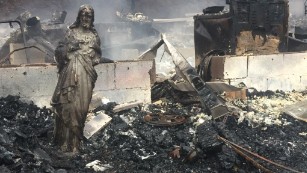
Statue of Jesus only thing left standing in house burned by Tennessee wildfire

A statue of Jesus was the only thing left standing after the wildfires swept through this house in Sevier County, Tennessee.
Fires still burn as rain falls in Gatlinburg.
 
(CNN)The pictures coming out of the Gatlinburg, Tennessee, wildfires are just devastating. Acres of woodland blackened. Row upon row of homes and businesses reduced to ashes.
But a TV crew with CNN affiliate WVLT spotted something of a miracle amid all that destruction. On Wednesday, reporter Kelsey Leyrer and her team captured footage of what they saw at a house out in Sevier County. It was a statue of Jesus -- covered with soot and ashes, but still standing. It was the only thing left after the home burned to the ground.
 
The Jesus statue was the second religious item this week that survived the wildfires. Earlier this week Isaac McCord, an employee at the Dollywood theme park, says he found a partially burned page from the Bible's book of Joel. The part of the passage that's readable, from Joel's first chapter reads, "O LORD, to thee will I cry: for the fire hath devoured the pastures of the wilderness, and the flame hath burned all the trees of the field."
 
McCord immediately took a picture of what he'd found and posted it to Facebook, where it's been shared tens of thousands of times. Many commenters took it as a sign from God.
 
"It provides hope and faith," McCord said. "That's why I shared it."
 
At least seven people have lost their lives in the wildfires that have ravaged Sevier County and Gatlinburg this week.