Feedzilla

Showing posts with label ANB Breaking News. Show all posts

Billy Graham, America's pastor, has died

 Photo: Larry W. Smith, Getty Images)

by Cathy Lynn Grossman, Special for USA TODAY
The world's best-known evangelist, the Rev. Billy Graham, has died. He was 99.

From the gangly 16-year-old baseball-loving teen who found Christ at a tent revival, Graham went on to become an international media darling, a preacher to a dozen presidents and the voice of solace in times of national heartbreak. He was America's pastor. 

Graham retired to his mountain home at Montreat, N.C., in 2005 after nearly six decades on the road calling people to Christ at 417 all-out preaching and musical events from Miami to Moscow. His final New York City crusade in 2005 was sponsored by 1,400 regional churches from 82 denominations.

Presidents called on Graham in their dark hours, and uncounted millions say he showed them the light. He took his Bible to the ends of the Earth in preaching tours he called "crusades." Even now, anywhere a satellite, radio, TV, video or podcast can reach, his sonorous voice is probably still calling someone to Christ.
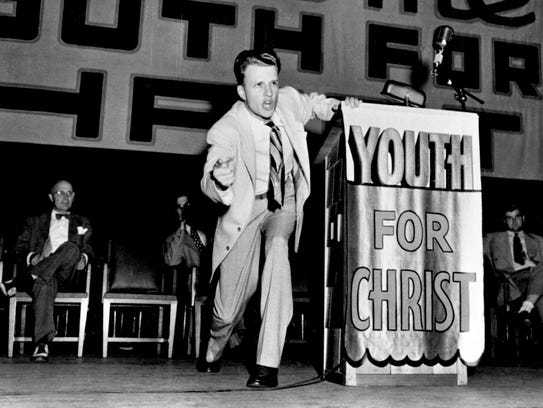


Though Graham's shoes could likely never be filled, his son, Franklin, has taken over in some aspects—leading The Billy Graham Evangelistic Association and becoming a confidant of President Donald Trump, including speaking at his inauguration.

But Franklin's message has swayed from his father's, leaving a mixed legacy for the Graham name.

Franklin has mocked both Islam and LGBT rights. He uses his following on social media to raise funds for "persecuted Christians," boycotts businesses that use gay couples in advertisements and blasts the separation of church and state as as the godless successor to Cold War communism.
But his father's words for years offered peace and perspective.

On the National Day of Prayer and Remembrance following the 9/11 attacks, Billy Graham spoke of the "mystery of iniquity and evil," of "the lesson of our need for each other" and, ultimately, of hope.

"He was so real, he made Christianity come true." observed Susan Harding, an anthropologist at the University of California-Santa Cruz. "He was homespun, historical and newsworthy all at once. He could span the times from Christ to today, from the globe to you, all in one sentence."

Grant Wacker, a Duke University professor of Christian history, says Graham represented, "what most decent churchgoing people thought and ought to think."

His reputation was untouched by sex or financial scandals. When anti-Semitic comments came to light as transcripts of conversations with Richard Nixon surfaced, Graham was promptly and deeply apologetic.

He never built a megachurch, set up a relief agency, launched a political lobby or ran for office. Yet he redefined American Protestant life by popularizing Christianity's core message — Christ died for your sins — downplaying denominational details and proclaiming the joys found in faith.

Graham was, however, drawn to power. Eventually, he met, prayed with, comforted and joked with 12 U.S. presidents, and Graham learned to walk a tightrope.

He found a fine balance that allowed him to become America's pastor, Democrat or Republican. North or South.
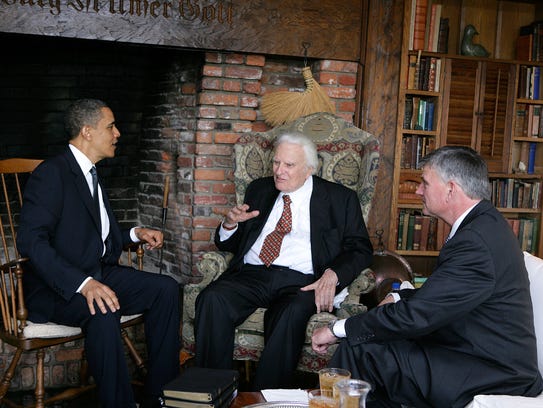


When President Clinton's affair with Monica Lewinsky came to light, Graham called for forgiveness. 

Clinton told Peter Boyer of The New Yorker, "He took sin seriously. But he took redemption seriously. And it was incredibly powerful the way he did it."

Former president George W. Bush has said it was a conversation with Graham that turned him from his drinking ways when he was young.

"I've never called him on a specific issue but his influence is bigger than a specific issue, as far as I'm concerned. He warms your soul," Bush told an ABC 20/20 special on the preacher and politics.

Graham emphasized the joy to be found in belief, in contrast to evangelists such as Jerry Falwell and Pat Robertson who routinely issued glowering condemnations of politicians or blamed natural disasters on modern culture. However, Graham did take an uncharacteristically political stand before the 2012 presidential election. He authorized full page ads in major newspapers in October urging people to vote for politicians who opposed same-sex marriage on "biblical principles."

He brought to the microphone a "corny but effective humor," Wacker says, which made him a convivial talk-show guest. Graham logged more than 50 radio or television interviews with Larry King alone. YouTube has a tape of Woody Allen interviewing the evangelist, who draws almost as many laughs as the caustic, agnostic comedian.

The Billy Graham Evangelistic Association he founded, now led by his son, Franklin, used every communications innovation possible to carry the Gospel to any willing heart on Earth. More than 214 million people in 195 cities and territories heard God's call in Graham's voice and witnessed him deliver the Gospel in person or by satellite links. His projects included founding Christianity Today magazine in 1956 and writing more than 30 books.

High among his numerous honors: The Congressional Gold Medal awarded to Billy and Ruth in 1996, the Presidential Medal of Freedom awarded to him in 1983, and the Templeton Foundation Prize for Progress in Religion in 1982. He even has a star on the Hollywood Walk of Fame.

"Fundamentalists saw him as excessively liberal, and liberals saw him as too literalist in talking about sin and salvation. His wonderful balance between them is critical to his legacy," says John Wilson, editor of Books & Culture, a sister publication of Christianity Today magazine

Graham's last decades were slowed by illness and injury. He was diagnosed with Parkinson's disease in 1989, felled by broken bones, bouts of hydrocephalous and rounds of pneumonia.

Age, illness and bone-breaking falls had left him struggling to deliver 20-minute sermons. 

Graham's last crusade, in June 2005 in New York City, drew 242,000 people to Flushing Meadows; 8,786 made a new commitment to Christ and thousands more renewed or rejoiced in their faith.

Then he retired to his Montreat, N.C., mountaintop log cabin home (where his five children grew up mostly without their traveling father) to spend his days with his beloved wife, Ruth. They shared Bible study, devotions and an endless recycling of the movie musicals she loved to watch. Those were bittersweet days, with Ruth bedridden and Billy relying on a walker. Their frequent prayer was, "Help me, Lord."


At her funeral in June 2007, Graham called Ruth the finest Christian he ever knew.

Graham lived through the explosion of religious diversity in America, the rise of the human potential movement and the trend to personalized spirituality. He also lived to see many tire of lonely seeking or a high-minded hopscotch from church to church, religion to religion.

Yet he remained steadfast in his response. In 1996, when he and Ruth were awarded the Congressional Gold Medal, he once more shared his faith in God with some of the most powerful men on Earth:

"As Ruth and I receive this award, we know that some day we will lay it at the feet of the one we seek to serve."

NASA: Legendary astronaut, moonwalker John Young has died


 (NASA via AP)
by MARCIA DUNN,
Legendary astronaut John Young, who walked on the moon and later commanded the first space shuttle flight, has died, NASA said Saturday. Young was 87.

The space agency said Young died Friday night at home in Houston following complications from pneumonia.

NASA called Young one of its pioneers - the only agency astronaut to go into space as part of the Gemini, Apollo and space shuttle programs, and the first to fly into space six times. He was the ninth man to walk on the moon.

"Astronaut John Young's storied career spanned three generations of spaceflight," acting NASA administrator Robert Lightfoot said in an emailed statement. "John was one of that group of early space pioneers whose bravery and commitment sparked our nation's first great achievements in space."

Young was the only spaceman to span NASA's Gemini, Apollo and shuttle programs, and became the first person to rocket away from Earth six times. Counting his takeoff from the moon in 1972 as commander of Apollo 16, his blastoff tally stood at seven, for decades a world record.

He flew twice during the two-man Gemini missions of the mid-1960s, twice to the moon during NASA's Apollo program, and twice more aboard the new space shuttle Columbia in the early 1980s.

His NASA career lasted 42 years, longer than any other astronaut's, and he was revered among his peers for his dogged dedication to keeping crews safe — and his outspokenness in challenging the space agency's status quo.

Chastened by the 1967 Apollo launch pad fire that killed three astronauts, Young spoke up after the 1986 shuttle Challenger launch accident. His hard scrutiny continued well past shuttle Columbia's disintegration during re-entry in 2003.

"Whenever and wherever I found a potential safety issue, I always did my utmost to make some noise about it, by memo or whatever means might best bring attention to it," Young wrote in his 2012 memoir, "Forever Young."

He said he wrote a "mountain of memos" between the two shuttle accidents to "hit people over the head." Such practice bordered on heresy at NASA.

Apollo 11 astronaut Michael Collins, who orbited the moon in 1969 as Neil Armstrong and Buzz Aldrin walked its surface, considered Young "the memo-writing champion of the astronaut office." 

Young kept working at Johnson Space Center in Houston "long after his compatriots had been put out to pasture or discovered other green fields," Collins wrote in the foreword of "Forever Young."

Indeed, Young remained an active astronaut into his early 70s, long after all his peers had left, and held on to his role as NASA's conscience until his retirement in 2004.

"You don't want to be politically correct," he said in a 2000 interview with The Associated Press. "You want to be right."

Young was in NASA's second astronaut class, chosen in 1962, along with the likes of Neil Armstrong, Pete Conrad and James Lovell.

Young was the first of his group to fly in space: He and Mercury astronaut Gus Grissom made the first manned Gemini mission in 1965. Unknown to NASA, Young smuggled a corned beef sandwich on board, given to him by Mercury astronaut Wally Schirra. When it came time to test NASA's official space food, Young handed Grissom the sandwich as a joke.

The ensuing scandal over that corned beef on rye — two silly minutes of an otherwise triumphant five-hour flight — always amazed Young. Sandwiches already had flown in space, Young said in his book, but NASA brass and Congress considered this one a multimillion-dollar embarrassment and outlawed corned beef sandwiches in space forever after.

Two years later, with Gemini over and Apollo looming, Young asked Grissom why he didn't say something about the bad wiring in the new Apollo 1 spacecraft. Grissom feared doing so would get him fired, Young said. A few weeks later, on Jan. 27, 1967, those wires contributed to the fire that killed Grissom, Edward White II and Roger Chaffee in a countdown practice on their Cape Canaveral launch pad.

It was the safety measures put in place after the fire that got 12 men, Young included, safely to the surface of the moon and back.

"I can assure you if we had not had that fire and rebuilt the command module ... we could not have done the Apollo program successfully," Young said in 2007. "So we owe a lot to Gus, and Rog and Ed. They made it possible for the rest of us to do the almost impossible."

Young orbited the moon on Apollo 10 in May 1969 in preparation for the Apollo 11 moon landing that was to follow in a couple months. He commanded Apollo 16 three years later, the next-to-last manned lunar voyage, and walked on the moon.

He hung on for the space shuttle, commanding Columbia's successful maiden voyage in 1981 with co-pilot Robert Crippen by his side. It was a risky endeavor: Never before had NASA launched people on a rocket ship that had not first been tested in space. Young pumped his fists in jubilation after emerging from Columbia on the California runway, following the two-day flight.
Crippen called flying with Young "a real treat."

"Anybody who ever flew in space admired John," said Crippen, a close friend who last spoke to him a few months ago.

Young made his final trek into orbit aboard Columbia two years later, again as its skipper.

Young's reputation continued to grow, even after he stopped launching. He spoke out on safety measures, even before the Challenger debacle.

"By whatever management methods it takes, we must make Flight Safety first. If we do not consider Flight Safety first all the time at all levels of NASA, this machinery and this program will NOT make it," he warned colleagues.

As then chief of the astronaut corps, Young was flying a shuttle training aircraft high above Kennedy Space Center when Challenger ruptured. He took pictures of the nose-diving crew cabin. The seven Challenger astronauts never knew of all the dangerous O-ring seal trouble leading up to their flight. 

"If I had known these things, I would have made them aware, that's for damn sure," Young wrote in his book.

Young noted that even his friends at NASA considered him "doom and gloom," and that a shuttle launch "always scared me more than it thrilled me."

He always thought the probability was there for a space shuttle accident, he observed in his autobiography, given that it was "such an incredibly complex machine."

"It wasn't pessimism. It was just being realistic," he wrote.

Yet Young maintained that NASA and the nation should accept an occasional spaceflight failure, saying it's worth the risk.

"I really believe we should be operating (the shuttle), flying it right now, because there's just not a lot we can do to make it any better," Young said in 2004, a year after the Columbia tragedy. Another year passed before shuttle flights resumed.

Throughout the 1990s and into the 2000s, Young maintained the United States should be doing two to three times the amount of space exploration that it was doing. NASA should be developing massive rockets to lift payloads to the moon to industrialize it, he said, and building space systems for detecting and deflecting comets or asteroids that could threaten Earth.

"The country needs it. The world needs it. Civilization needs it," Young said in 2000, adding with a chuckle, "I don't need it. I'm not going to be here that long."

In his book, Young noted that his "relentless" stream of memos about volcanic super-eruptions and killer asteroids was aimed at scaring and educating at the same time. Humans need to start living off the planet in order to save the species, he stressed again and again, pointing to the moon. "Some folks surely regarded me as a crackpot," he wrote. "But that didn't stop me."

Young spent his last 17 years at NASA's Johnson Space Center in Houston in management, focusing on safety issues. He retired at the end of 2004, seven months shy of NASA's return to space following the Columbia accident.

Young was born Sept. 24, 1930 and grew up in Orlando, Florida. He became interested early on in aviation, making model planes. He spent his last high school summer working on a surveying team. 

The job took him to Titusville due east of Orlando; he never imagined that one day he would be sitting on rockets across the Indian River, blasting off for the moon.

He earned an aeronautical engineering degree from Georgia Institute of Technology in 1952 and went on to join the Navy and serve in Korea as a gunnery officer. He eventually became a Navy fighter pilot and test pilot.

Young received more than 100 major accolades in his lifetime, including the prestigious Congressional Space Medal of Honor in 1981.

Even after leaving NASA, he worked to keep the space flame alive, noting in his official NASA biography that he was continuing to advocate the development of technologies "that will allow us to live and work on the moon and Mars."

"Those technologies over the long (or short) haul will save civilization on Earth," he warned in his NASA bio, almost as a parting shot.
__
AP Science Writer Seth Borenstein and AP writer Julie Watson contributed. Dunn reported from Cape Canaveral, Florida.
___
This story has been corrected to clarify that Robert Lightfoot is acting NASA administrator.

10 Killed, 29 Wounded In MLK Day Weekend Shootings


CHICAGO (CBS) — At least 39 people have been shot across Chicago over the Martin Luther King Jr. Day holiday weekend, leaving 10 dead.

The latest killing happened at 11:36 a.m. Monday in the West Side Austin neighborhood, where a vehicle pulled up to 24-year-old Allante Elmore on a porch near his home in the 4800 block of West Hubbard, and shot him repeatedly, according to Chicago Police and the Cook County medical examiner’s office. He was taken to Stroger Hospital, where he died.

About 1:10 a.m., 36-year-old Marlon Pollard was standing outside in the 2200 block of West Chicago in the Ukrainian Village neighborhood when someone in a black SUV opened fire, striking him in the abdomen, face and left leg. The Evanston resident died in less than an hour at Stroger, authorities said.

Early Sunday on the Near West Side, officers responded to a call of a person down about 5:30 a.m. in the 2600 block of West Van Buren and found a man in his 30s or 40s dead at the scene with a gunshot wound to the head, according to authorities, who were still working to identify him.

About 1:15 a.m., a 34-year-old man was gunned down in the Lawndale neighborhood on the West Side.He got into an argument with someone who shot him in the chest in the 4700 block of West Polk, police said. He died at Mount Sinai Hospital, authorities said. His name has not been released.

Saturday night, a 26-year-old man was killed in an Austin drive-by shooting. He was outside in the 5500 block of West Rice about 7 p.m. when a vehicle drove by and someone shot him multiple times. The man, who has not been identified, was taken to Mount Sinai, where he was pronounced dead, authorities said.

Two hours before that, an 18-year-old man was gunned down in another Austin attack. A dark-colored car pulled up to 18-year-old Christopher Johnson Jr. about 5 p.m. in the 400 block of South Central Avenue, and someone inside shot him twice in the abdomen, authorities said. Johnson, of the 7300 block of South Michigan, died at Mount Sinai at 1:35 p.m. Monday.

Two men, ages 27 and 39, were standing in the street at 8:05 a.m. Saturday in the 1100 block of South Francisco in Lawndale when someone got out of a black car and fired multiple shots, police said.

They were taken to Mount Sinai, where the younger man died of wounds to the head and chest, authorities said. His name has not been released. The older man was in good condition with a back wound.

Another man was killed and a woman was wounded about 3:30 a.m. Saturday in the South Side Englewood neighborhood, where at least five people went into a house in the 6000 block of South Carpenter and shot two people repeatedly. Tyrone Blake, 25, of the 6100 block of South Indiana, was pronounced dead at the scene at 3:48 a.m., authorities said. The 26-year-old woman was taken in critical condition to Stroger Hospital.

A 20-year-old man was slain shortly before 10 p.m. Friday in the Marquette Park neighborhood on the Southwest Side. Devonta Spraggins was driving east on 72nd Street when a white Ford Explorer pulled up to him near Washtenaw Avenue and someone inside the vehicle shot him in the chest, authorities said. Spraggins, who lived a block away in the 7200 block of South Talman, was taken to Christ Medical Center in Oak Lawn, where he died at 10:22 p.m.

The weekend’s first fatal shooting happened about 4 p.m. Friday in Austin, where a 21-year-old man got into an argument with someone who opened fire in the 600 block of North Central Avenue. The man suffered multiple gunshot wounds and was taken to West Suburban Medical Center in Oak Park, where he was pronounced dead at 4:18 p.m., according to authorities, who have withheld his name.

Shortly after midnight Sunday in the East Garfield Park neighborhood, a Chicago Police officer chased and fatally shot 34-year-old Herbert Johnson, who was armed and suspected of being involved in another shooting in the nearby 3300 bock of West Monroe, authorities said. A 51-year-old woman was found with a gunshot wound to the chest, a 30-year-old man was shot in the buttocks and a 21-year-old woman suffered a graze wound to the left leg. The Independent Police Review Authority is investigating the officer’s use of force.

At least 24 more people were wounded in nonfatal shootings across Chicago between 5 p.m. Friday and 10 p.m. Monday. Last year, 32 people were shot over the Martin Luther King Jr. Day holiday weekend, five fatally.
 
(Source: Sun-Times Media Wire © Chicago Sun-Times 2017.

BREAKING: Israel Pleads for Trump’s Help After Obama Ambush, Trump Call Egyptian President and Changes EVERYTHING


by Conservative Tribune
When Egypt was about to sponsor a resolution before the United Nations condemning Israel over settlements and the Obama administration wasn’t going to anything, President-elect Donald Trump sprung into action. And while the anti-Israel resolution still passed, Trump still managed to show that he was able to take care of the Jewish state in a way Obama never would.

According to The Washington Post, while the resolution was eventually re-sponsored by other governments, Trump was able to convince the Egyptian government to withdraw their sponsorship of it.

“On Friday, Egypt said its president had received a call from Trump in which they both agreed to give the incoming U.S. administration a chance to try and resolve the Israeli-Palestinian conflict. The call came hours after Egypt indefinitely postponed the U.N. vote,” The Washington Post said.

A statement from Egypt said that after Trump spoke with the president, they agreed upon “the importance of giving a chance for the new American administration to deal in a comprehensive way with the different aspects of the Palestinian issue with the aim of achieving a comprehensive and a final resolution.”

In spite of all that, Obama decided not to give the new administration a chance to deal with the Israeli-Palestinian issue, abstaining on the vote when the resolution came up and thus allowing it to pass, according to The New York Times.

In other words, Egypt is apparently more willing to work with Donald Trump and Israel than the Obama administration is. I guess we shouldn’t be surprised.

“It was to be expected that Israel’s greatest ally would act in accordance with the values that we share and that they would have vetoed this disgraceful resolution,” Israeli Ambassador Danny Danon said, according to Fox News. “I have no doubt that the new U.S. administration and the incoming UN Secretary General will usher in a new era in terms of the UN’s relationship with Israel.”

Given Trump’s actions with Israel, we have hope. And given the fact that Obama’s anti-Israel administration will be out of office soon, we have a lot more hope.

Please like and share on Facebook and Twitter if you think America should stand by Israel.

Marines Helping our homeless Veterans!


FOR IMMEDIATE RELEASE: 11/25/2016
Missy Buchart / Business Development
2016 Board Member, The BOOYAH Veteran Bus Project
BOOYAH Mortgage | Branch NMLS #1499800
250 International Parkway Suite 134
Lake Mary, FL 32746
Office: 1-844-7BOOYAH
Cell: 407-448-8538
Fax: 407-386-6491
www.booyahveteranbusproject.com


GIVE. GOLF. DINE.
2016 ClubCorp Charity Classic Golf Tournament
Hosted by Debary Golf and Country Club

When: December 3rd, 2016
Where: The DeBary Golf and Country Club, 300 Plantation Club Drive, Debary, FL 32713
Time: Registration and breakfast opens at 7:00am, shotgun start, 8:30am
What: Premier/luxury items Silent Auction
18-hole golf tournament: until all players complete
Luncheon/awards ceremony/silent auction approx 2:00pm

Each year, ClubCorp chooses 2 National Charities to support with their events (Augie’s Quest, and EPCF –this year) AND they allow each event location venue to choose a THIRD, local charity as a way to make sure to give back directly to local community.

This year they chose us! The BOOYAH Veteran Bus Project.

Our mission statement...
“Helping America’s Veterans by seeking to end Veteran homelessness & providing medical transportation & post-service education.” - Shane Johnson Founder/CEO Booyah Mortgage

Our mission…

Phase #1 On October 22, 2016 - Marines Shane Johnson, Shawn Moore & Richard Mccuen left the Veterans Medical Center, Lake Nona and marched over 400 miles to Panama City to raise awareness about the homeless Veteran problem.

Phase #2 February 2017 - A bus for needy Veterans will be completed that will provide medical transportation, showers, washer and dryer plus haircuts and hot meals.

Phase #3 Summer of 2017 - Ground breaking for a project that includes a 13-week housing program, vocational training with mentors and job opportunities upon graduation.

Since 2007, ClubCorp has raised more than $17 million in its annual Charity Classic. This year 2016 ClubCorp Charity Classic Golf Tournament’s goal is to raise $15,000 for Booyah Veteran Bus Project, Augie’s Quest, and Employee Partners Care Foundation.

This will be ClubCorp’s tenth year of giving back to the community by donating the use of their golf courses, restaurant facilities and staff to assist charities in fundraising so that these worthy organizations continue the work of helping and educating people in our community.

We are asking for your support in providing media coverage of this event.

To participate please go to: clubcorpcharityclassic.com or call: 386-668-1705 ext. 227

Do not miss the chance to support your community. We look forward to you joining the local business leaders in our community and making this the best ClubCorp Charity Classic yet!

Sincerely,
Missy Buchart / Business Development
Booyah Mortgage

Police officers shot in Texas, Missouri and Florida

By Jim Forsyth
SAN ANTONIO (Reuters) - A police officer was killed in Texas and another wounded in Missouri in apparently unrelated ambush-style shootings, while a third officer was shot and wounded in Florida, authorities said on Monday.

The latest attacks on U.S. law enforcement revived painful memories of deadly ambushes targeting police in July in Dallas and Baton Rouge.

A manhunt was underway for the suspect who killed the officer in San Antonio, Texas, while the suspect in the Missouri shooting died in a shootout with authorities.

In Sunday's first incident, 50-year-old Benjamin Marconi, a 20-year veteran of the San Antonio force was fatally shot as he sat in his squad car during a routine traffic stop outside the city's police headquarters.

The assailant stopped his car behind the police cruiser, walked up and shot the officer in the head through the window as he was writing a ticket, Police Chief William McManus said.

The gunman then reached through the window, fired a second shot into the officer, returned to his vehicle and sped away.

Hours later, a 46-year-old St. Louis police sergeant was shot in the face by someone in a car who pulled up beside the officer's cruiser at an intersection, opened fire, then fled. St. Louis Police Chief Sam Dotson said the wounded officer was conscious and able to speak after the attack.

The suspect was later killed in a shootout after officers spotted his car, police said on Monday.

The unidentified suspect was wanted for other violent crimes and likely shot the officer "in fear of being recognized," police said in a statement.

'WORST NIGHTMARE'
Meanwhile, a third police officer was shot during a traffic stop on Sanibel Island on Florida's Gulf Coast, but was not seriously hurt, local media reported.

The officer was treated for a shoulder wound and later released from the hospital, according to the reports, while the suspect was apprehended at his home on an island off Ft. Myers.

Investigators in Texas said they did not have any immediate clues to the identity of the San Antonio gunman. They found no apparent link with the man who had been pulled over, McManus told reporters.

"This is everyone's worst nightmare," McManus said. Referring to the recent ambush killings of police officers in Texas and Louisiana, he said, "You never want to see anything like this happen. Unfortunately, like Dallas, like Baton Rouge, it's happened here now."

McManus said the suspect's image was captured by security cameras.

McManus did not say whether police believe there was a racial element to the shooting. He said San Antonio officers were being ordered to call for backup during traffic stops.

The latest shootings come amid an intense national debate over the role of law enforcement and especially the use of force by officers against minorities.

In July, five Dallas police officers were killed when a black U.S. military veteran opened fire during a protest against police shootings of black men. Days later, a gunman killed three police officers and wounded four others in Baton Rouge.

Earlier this month, an Iowa man was charged with killing two police officers who were shot in their patrol cars in the Des Moines area. He had been ejected by police from a high school football game after waving a confederate flag at black spectators.

A total of 57 U.S. law enforcement officers have been killed by gunfire so far this year, a 68 percent increase from the same period in 2015.

Tsunami hits New Zealand after massive quake


Seismologist says tidal surge of up to one metre has been recorded in North Canterbury region of the New Zealand's South Island * USGS says quake magnitude revised to 7.8
* NZ authorities warn of risk of destructive waves
* East coast residents urged to seek higher ground
* Hotels, apartment buildings evacuated in Wellington (Adds details of damage, including to power and phone networks)

By Charlotte Greenfield
WELLINGTON, Nov 14 (Reuters) - An earthquake with a magnitude of 7.8 struck central New Zealand just after midnight, the U.S. Geological Survey said, causing widespread damage and generating a tsunami.

New Zealand's Ministry of Civil Defence and Emergency Management warned of the risk of destructive waves along the country's entire east coast and urged residents in low-lying areas to evacuate and seek higher ground.

Waves of up to two metres (6 feet) could be possible for up to two hours, it said.

Anna Kaiser, a seismologist at GNS Science said a tidal signal or surge of up to one metre (3 feet) had been recorded in North Canterbury region of the South Island.

"That's reasonably significant so people should take this seriously," she told Radio New Zealand.
New Zealand's Geonet revised up its estimated magnitude of the quake to 7.5, from 6.6 earlier.

USGS said the quake was centred 91 km (57 miles) north-northeast of Christchurch, the biggest city on New Zealand's South Island.

A 6.3 quake there in February 2011 killed 185 people and caused widespread damage.

The tremor was felt throughout most of New Zealand. Some injuries had been reported but there no immediate reports of deaths.

"The whole house rolled like a serpent and some things smashed, the power went out," a woman, who gave her name as Elizabeth, told Radio New Zealand from her home in Takaka, near the top of the South Island.

Chris Hill, a fire officer in Cheviot, a coastal town near the quake's epicentre, said officials had gone door to door evacuating residents.

"Everyone seems OK here," he told RNZ. "There's a lot of debris in houses, but at this stage it doesn't look like anything too bad has happened."

Residents in Wellington said glass had fallen from buildings into the streets and hotels and apartment buildings had been evacuated.

Richard Maclean, a spokesman for the Wellington City Council, said residents had been evacuating the city's southern coastal suburbs due to the tsunami threat and there had been reports of structural damage to several buildings.

"We've got reports of broken water pipes and lots and lots of things off desks and shelves," he told RNZ.

Several roads around the South Island had been closed and damage to power and phone networks was reported.

A series of aftershocks were recorded around the country, some as strong as 6.1 magnitude.

Pictures shared on social media showed buckled roads, smashed glass and goods toppled from shelves in shops in Wellington and the upper South Island. (Additional reporting by Colin Packham, Byron Kaye, Jane Wardell in Sydney; Writing by Lincoln Feast; Editing by Neil Fullick)

'This storm will kill you'

Tailbacks leave thousands in gridlock across the East Coast as two million are told to flee deadly hurricane Matthew as it kills 102 and prepares to hit the US TODAY

  • Hurricane Matthew is expected to hit southern Florida late this evening and move up the East Coast 
  • Powerful storm claimed at least 102 lives as it ripped through Haiti and the Dominican Republic on Tuesday
  • The storm intensified to a 'catastrophic' Category Four this morning with sustained winds of 140mph 
  • National Weather Service has advised 'loss of life' and 'immense human suffering' is possible 
  • Approximately seven million people could be left without power and some areas left 'uninhabitable' 
  • Two million people in the US have been urged to evacuate their homes in preparation for a 'direct hit'
  • Gov. Scott warned Florida warns that the storm 'is going to kill people' after declaring a state emergency 
  • South Carolina Gov. Nikki Haley said only 175,000 have evacuated so far, warning 'that's not enough' 
  • Eerie satellite images of Matthew over Haiti show the storm forming a grinning skull with glowing red eye  
More than two million people in the US have been urged to evacuate their homes because Hurricane Matthew 'is going to kill people' as it strengthens on its way towards the East Coast.

Thousands of families have been caught in gridlock in Florida, the Carolinas and Georgia after fleeing their homes ahead of the storm - which is expected to strike Miami early on Friday morning with winds of up to 145mph.

Governor Rick Scott of Florida, reiterating a call for people to evacuate on Thursday morning said there is no reason not to leave the state.

'Do not surf. Do not go on the beach. This will kill you,' he said. 

The powerful Category Four hurricane, the fiercest Caribbean storm in nearly a decade, has already killed at least 98 people in Haiti and four in the Dominican Republic. At its height, the hurricane was a Category Five with wind speeds of more than 157 mph.

The National Weather Service has advised that 'loss of life' and 'immense human suffering' is possible for those who don't take precautions. It could also potentially leave approximately seven million people without power.

President Barack Obama warned: 'I want to emphasize to the public - this is a serious storm. If there is an evacuation order in your community, you need to take it seriously.'

'Just remember that you can always rebuild,' he added. 'You can always repair property. You cannot restore a life if it is lost and we want to make sure that we minimize any possible loss of life or risk to people in these areas.

The storm gained new muscle over the Bahamas on Thursday morning as it battered the island, intensifying from a Category Three with wind speeds of 120mph, to Category Four with 140mph speeds. 

The National Hurricane Center warned at 5am that it was about 60 miles south-southeast of Nassau, the capital, which is located on New Providence – home to about 70 per cent of the country's 250,000 people.

Forecasters said the hurricane is likely to hit Florida at around 2am on Friday before heading northwards past Orlando, Jacksonville and up to Charleston.

Gov. Rick Scott has activated 2,500 National Guard to help with the evacuations across the state - and the aftermath of the hurricane. Another 4,000 available if needed, Scott said. 

'We are going to get ready, but this is going to be catastrophic,' he warned. 'If you need to evacuate and you haven't, evacuate. Time is running out.' 

Some models have suggested that the storm may go out to sea and then do a U-turn and head back to Florida for a devastating double hit.

Gov Scott, warned his state that they needed to 'prepare for a direct hit' as he declared a state of emergency.

'That means people have less than 24 hours to prepare, evacuate and shelter. Having a plan in place could mean the difference between life and death.'

He added that all residents on Florida's Atlantic coast should expect to lose power, 'possibly for a long period of time.' 

'We don't know exactly where this storm's going. Don't trust this track.'

He warned of heavy rain, strong rip currents, beach erosion and storm surge.

'Unfortunately this is going to kill people,' he reiterated. 

'Evacuate, evacuate, evacuate. Be prepared. Don't take a chance.' 

As well as the potential loss of life, researchers at the University of Michigan, Ohio State and Texas A&M have warned Matthew could knock out power for approximately seven million people. 

The National Weather Service also warned that the hurricane could cause the 'complete destruction of mobile homes' adding that certain areas could be rendered 'uninhabitable for weeks of months'. 

Some 3,000 people have already checked into shelters across the state ahead of Matthew's approach.

In preparation, residents flocked to hardware stores, grocery stores and gas stations, stripping them of vital supplies.

One Florida, resident Randy Jordan of Juniper, told WPEC people were shoving each other as they raced to buy the supplies they needed at the local Home Depot.

'The vibe on the street this morning is pre-panic,' Jordan said. 'By tomorrow, it should just be a brawl.'

Evacuations began Wednesday and at 3pm, Brevard County commissioners ordered one of the Florida's first evacuations for residents of Merritt Island and other barrier islands.

Martin County has also ordered for homes along the Barrier Islands and Sewall's Point, as well as for residents living in low-lying areas or manufactures homes.

In South Florida, lines at grocery stores were heavier than usual and some essentials were in short supply.

When Simone Corrado and her husband tried to buy water at their Publix in Davie near Fort Lauderdale, they mostly found empty shelves.

There were a few bottles of high-end water brands, but there was so much empty shelf space that Corrado lay down and fully stretched out on the bottom shelf.

'I got scared because all that was left at Publix was just the pricey water,' said Corrado, who lived through 1992's catastrophic Hurricane Andrew, which practically leveled the nearby city of Homestead.

'They really put the fear into you here. On the television screen every few minutes is the 'beep, beep, beep' storm alert.'

Near Miami Beach, The Home Depot in Davie briefly ran out of propane for gas barbecues and the supply of batteries was dwindling.

People bought plywood to cover windows, tarps to put over outdoor furniture and coolers for food storage.

Anesthesiologist Darby Lipka lugged a 20-pound propane tank across the parking lot, saying he had already purchased food and water. He installed hurricane windows years ago so he wouldn't need to erect shutters

'I am just trying to be prepared,' he said.

Dane Vaala, a diesel mechanic, was loading plywood onto his pickup. He needed it so he could stand on his awning to install upper floor shutters at his home.

He moved to Florida from Montana in 2007, so Matthew would be his first storm. 

He had loaded up on canned food and water.

'I'm not too concerned — it doesn't really bother me much,' he said. 'But it is better to prep.'

Theme parks such as Walt Disney World, Universal and Sea World were also keeping a close eye on the storm and warned customers they could expect different closing times. As of this morning, they remained open, but Disney World cancelled 'Mickey's Not So Scary Halloween Party', a special event scheduled for tonight.

South Carolina has told about a quarter million people to leave the coast and Scott's counterpart Gov. Nikki Haley says she currently plans to order more evacuations for two more counties today, bringing the total to about 500,000 people.

At a press conference this morning, she urged South Carolina residents to fuel up and evacuate now as everything from gas stations to pharmacies prepared to close.  

'As of 6am this morning, 175,000 people have been evacuated,' she told reporters. 'That's not enough. 

We need to have more people evacuating. 

'If you are still sitting at home, if you have not evacuated; gas stations are getting ready to close, your pharmacies are getting ready to close. Everything is going to leave because people have to protect their own families. We really do need you to think about that.'

Charleston and Beaufort will continue their evacuation, and Horry and Georgetown counties will begin theirs at noon today. Bordering coastal counties - Berkeley, Colleton, Dorchester and Jasper counties - should also evacuate.

'We've been though winter storms. We've been through a 1,000-year flood. A hurricane is different. I don't want anyone to look at the last couple of tragedies we've gone through and think this is similar,' Haley said.

'We want everyone to be careful, we want everyone to take this seriously.'

City officials in Charleston, which weathered Category Four Hurricane Hugo almost 30 years ago, warned the city had run out of sandbags after distributing more than for any other storm. The city has distributed more than 15,000 sandbags.

A motorist in South Carolina's Berkeley County was shot and killed by deputies during an altercation over an evacuation route. 

Lucas M. Felkel of Moncks Corner, 35, came to a check point, knocked down some traffic cones and sped off. Sheriff Duane Lewis said when deputies caught up with the driver a few miles away he pointed a gun at them and started shooting.

'His actions placed the officers in danger,' local Sheriff Duane Lewis said. 

The sheriff says when deputies finally caught up with the driver a few miles away he pointed a gun at deputies and started shooting. The sheriff says the deputies shot back, wounding the man who was taken to the hospital, where he died at 7pm yesterday.

As residents in the Southeast prepared to leave their homes behind, many found that trying to get out of town was difficult due to the sheer numbers of people leaving at the same time.

Hundreds of thousands were stuck in traffic on highways due to evacuation orders being issued by government officials.

'It was bumper to bumper and fairly slow for about 30 to 40 miles on either side of I-95,' Sarah Boessenecker told NBC News.

'However, people were very friendly and easygoing — no honking or impatience'.

'People seemed to know the drill and understand that traffic was going to be bad and had accepted it.'

She and her husband, Robert were trying to make the trip from Charleston, South Carolina to Atlanta, where friends had offered to host them.

For Lydia Dalton, she said it took her family a 'long time to get out of Charleston' on Interstate 26.

'We thought we were leaving way ahead of everyone else,' Dalton said.