MOORHEAD—Successful entrepreneur and hotel
magnate Gary Tharaldson shared stories from his business career during
an event at Minnesota State University Moorhead on Monday, April 16,
wowing his audience with tales of how a boy who grew up near Dazey,
N.D., on a farm that didn't have running water built a company that was
sold to its employees in 1999 for about $1 billion.
About 15
years later, those employees walked away with about $600 million when
they sold the company, providing many with a significant retirement
fund, according to Tharaldson.
He
said creating the employee stock ownership plan that made that possible
is one of his proudest accomplishments in a career that is still going
strong and is now chronicled in a book titled, "Open Secrets of Success:
the Gary Tharaldson Story," which is available on Amazon and was
written by Patrick J. McCloskey.
Tharaldson said the book
reflects his long-held practice of answering questions anytime people
ask him how he has gotten to where he is.
When it comes
to building hotels, Tharaldson's formula is simple: he teams only with
high-quality brands like Marriott and only builds in areas where
demographics almost guarantee success.
To help ensure
that, he said he determines who the major competitors are in a community
and then builds hotels with about 20 percent fewer rooms, which he says
usually results in higher occupancy rates and above-average profit
margins, usually around 40 percent.
"I stack the deck for
myself," Tharaldson said, adding that success comes in many forms and
for him it's not necessarily making lots of money.
"If you're truly doing what you love to do, then you're successful," he said.
Asked
what he feels are his three strongest talents, Tharaldson listed
attitude and a willingness to learn, as well as adopting a common sense
approach to most things.
When he struggled to come up with a third talent, his wife, Connie, supplied the rest:
"He never gives up," she said. "He finds a way to keep going and never, ever, gives up."
Tharaldson
told the audience, which was mainly MSUM students, that a major part of
what has made his hotels successful is the fact employees were given a
stake in whether the business succeeded or not.
"They acted like owners. They took pride in everything they did, knowing someday there would be a payday," Tharaldson said.
"This is a phenomenal story of Gary Tharaldson's incredible
accomplishment. Starting with nothing, he built over 400 hotels by
himself, no partners-more than any single individual worldwide. What an
inspiration to young people across the country!" -- Rudy Ruettiger,
motivational speaker and subject of the 1993 film "Rudy," ranked among
the top inspirational movies by the American Film Institute. "Gary is so
down-to-earth, he's actually subterranean. I was one of the fortunate
ones because Gary shared everything with us: his building costs and
operating numbers, which were tops in the industry, and how he produced
them." -- Bruce White, Chairman, Founder and CEO of White Lodging.
You can order your copy on Amazon by clicking on the link below:
U.S. stocks traded higher on Friday after the release of stronger-than-expected employment data.
The Dow Jones industrial average rose 200 points, with Intel as the best-performing stock in the index. The S&P 500 gained 0.8 percent, with energy as the best-performing sector. The Nasdaq composite
advanced 0.9 percent. The Nasdaq 100, which is made up of the 100
largest companies in the Nasdaq composite, reached an all-time high.
The U.S. economy added 313,000 jobs in February, according to the Bureau of Labor Statistics. Economists polled by Reuters expected a gain of 200,000.
Wages, meanwhile, grew less than
expected, rising 2.6 percent on an annualized basis.
Stronger-than-expected wage growth helped spark a market correction in
the previous month.
"As far as the market is
concerned, you couldn't have scripted it any better," said JJ Kinahan,
chief market strategist at TD Ameritrade. But "it still remains a
mystery how you can create these many jobs and not have wages go up
more."
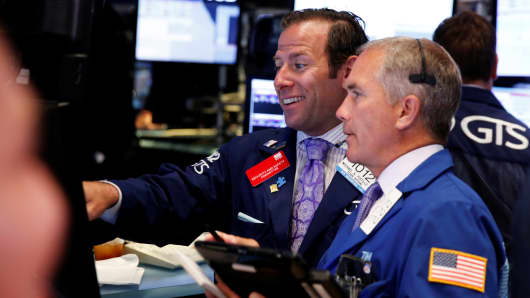
Traders work on the floor of the New York Stock Exchange shortly after the opening bell in New York.
President Donald Trump signed two declarations on Thursday, which would implement tariffs on steel and aluminum imports.
The tariffs are expected to take effect in 15 days and will put a 25
percent charge on steel, and 10 percent on aluminum. Canada and Mexico
however are exempt.
"I'm glad to see Canada
and Mexico was spared in the latest tariff initiatives," said Peter
Boockvar, chief investment officer at Bleakley Advisory Group, in a
note. "But, 75% of our trading partners were slapped. I get that China
was the real target here but we import 13% of our steel from Brazil, 10%
from South Korea, 5% from Japan, 4% from Germany and 3.5% from Taiwan
to name some others."
Friday also marked the
nine-year anniversary of the bull market. It also marks the "Haines
Bottom." Before the open on March 10, 2009, CNBC anchor Mark Haines
called the bottom of the financial crisis on air.
On March 9, 2009, the S&P 500 closed at 676.53. Since then, the S&P 500 is up around 300 percent.
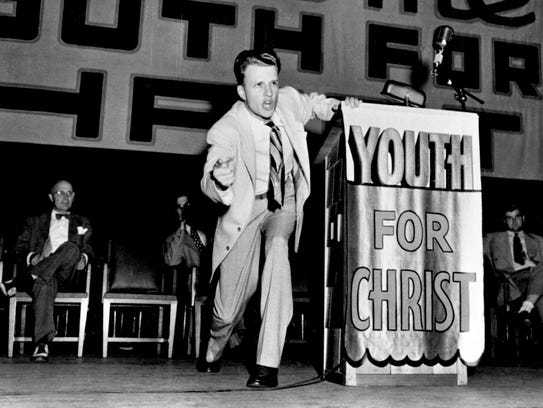
The world's best-known evangelist, the Rev. Billy Graham, has died. He was 99.
From
the gangly 16-year-old baseball-loving teen who found Christ at a tent
revival, Graham went on to become an international media darling, a
preacher to a dozen presidents and the voice of solace in times of
national heartbreak. He was America's pastor.
Graham retired
to his mountain home at Montreat, N.C., in 2005 after nearly six
decades on the road calling people to Christ at 417 all-out preaching
and musical events from Miami to Moscow. His final New York City crusade
in 2005 was sponsored by 1,400 regional churches from 82 denominations.
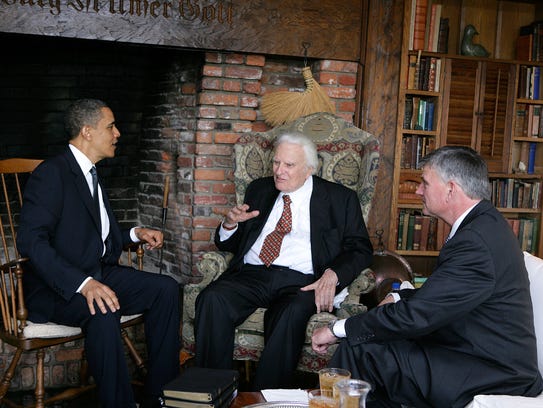
Presidents
called on Graham in their dark hours, and uncounted millions say he
showed them the light. He took his Bible to the ends of the Earth in
preaching tours he called "crusades." Even now, anywhere a satellite,
radio, TV, video or podcast can reach, his sonorous voice is probably
still calling someone to Christ.
Though
Graham's shoes could likely never be filled, his son, Franklin, has
taken over in some aspects—leading The Billy Graham Evangelistic
Association and becoming a confidant of President Donald Trump,
including speaking at his inauguration.
But Franklin's message has swayed from his father's, leaving a mixed legacy for the Graham name.
Franklin
has mocked both Islam and LGBT rights. He uses his following on social
media to raise funds for "persecuted Christians," boycotts businesses
that use gay couples in advertisements and blasts the separation of
church and state as as the godless successor to Cold War communism.
But his father's words for years offered peace and perspective.
On
the National Day of Prayer and Remembrance following the 9/11 attacks,
Billy Graham spoke of the "mystery of iniquity and evil," of "the lesson
of our need for each other" and, ultimately, of hope.
"He
was so real, he made Christianity come true." observed Susan Harding,
an anthropologist at the University of California-Santa Cruz. "He was
homespun, historical and newsworthy all at once. He could span the times
from Christ to today, from the globe to you, all in one sentence."
Grant
Wacker, a Duke University professor of Christian history, says Graham
represented, "what most decent churchgoing people thought and ought to
think."
His reputation was untouched by sex or
financial scandals. When anti-Semitic comments came to light as
transcripts of conversations with Richard Nixon surfaced, Graham was
promptly and deeply apologetic.
He never built a
megachurch, set up a relief agency, launched a political lobby or ran
for office. Yet he redefined American Protestant life by popularizing
Christianity's core message — Christ died for your sins — downplaying
denominational details and proclaiming the joys found in faith.
Graham
was, however, drawn to power. Eventually, he met, prayed with,
comforted and joked with 12 U.S. presidents, and Graham learned to walk a
tightrope.
He found a fine balance that allowed him to become America's pastor, Democrat or Republican. North or South.
When
President Clinton's affair with Monica Lewinsky came to light, Graham
called for forgiveness.
Clinton told Peter Boyer of The New Yorker, "He
took sin seriously. But he took redemption seriously. And it was
incredibly powerful the way he did it."
Former
president George W. Bush has said it was a conversation with Graham that
turned him from his drinking ways when he was young.
"I've
never called him on a specific issue but his influence is bigger than a
specific issue, as far as I'm concerned. He warms your soul," Bush told
an ABC 20/20 special on the preacher and politics.
Graham
emphasized the joy to be found in belief, in contrast to evangelists
such as Jerry Falwell and Pat Robertson who routinely issued glowering
condemnations of politicians or blamed natural disasters on modern
culture. However, Graham did take an uncharacteristically political
stand before the 2012 presidential election. He authorized full page ads
in major newspapers in October urging people to vote for politicians
who opposed same-sex marriage on "biblical principles."
He
brought to the microphone a "corny but effective humor," Wacker says,
which made him a convivial talk-show guest. Graham logged more than 50
radio or television interviews with Larry King alone. YouTube has a tape
of Woody Allen interviewing the evangelist, who draws almost as many
laughs as the caustic, agnostic comedian.
The
Billy Graham Evangelistic Association he founded, now led by his son,
Franklin, used every communications innovation possible to carry the
Gospel to any willing heart on Earth. More than 214 million people in
195 cities and territories heard God's call in Graham's voice and
witnessed him deliver the Gospel in person or by satellite links. His
projects included founding Christianity Today magazine in 1956 and writing more than 30 books.
High
among his numerous honors: The Congressional Gold Medal awarded to
Billy and Ruth in 1996, the Presidential Medal of Freedom awarded to him
in 1983, and the Templeton Foundation Prize for Progress in Religion in
1982. He even has a star on the Hollywood Walk of Fame.
"Fundamentalists
saw him as excessively liberal, and liberals saw him as too literalist
in talking about sin and salvation. His wonderful balance between them
is critical to his legacy," says John Wilson, editor of Books & Culture, a sister publication of Christianity Today magazine.
Graham's
last decades were slowed by illness and injury. He was diagnosed with
Parkinson's disease in 1989, felled by broken bones, bouts of
hydrocephalous and rounds of pneumonia.
Age, illness and bone-breaking falls had left him struggling to deliver 20-minute sermons.
Graham's last crusade, in June 2005 in New York City,
drew 242,000 people to Flushing Meadows; 8,786 made a new commitment to
Christ and thousands more renewed or rejoiced in their faith.
Then
he retired to his Montreat, N.C., mountaintop log cabin home (where his
five children grew up mostly without their traveling father) to spend
his days with his beloved wife, Ruth. They shared Bible study, devotions
and an endless recycling of the movie musicals she loved to watch.
Those were bittersweet days, with Ruth bedridden and Billy relying on a
walker. Their frequent prayer was, "Help me, Lord."
At her funeral in June 2007, Graham called Ruth the finest Christian he ever knew.
Graham
lived through the explosion of religious diversity in America, the rise
of the human potential movement and the trend to personalized
spirituality. He also lived to see many tire of lonely seeking or a
high-minded hopscotch from church to church, religion to religion.
Yet
he remained steadfast in his response. In 1996, when he and Ruth were
awarded the Congressional Gold Medal, he once more shared his faith in
God with some of the most powerful men on Earth:
"As Ruth and I receive this award, we know that some day we will lay it at the feet of the one we seek to serve."