Feedzilla

Homebuilder sentiment spikes 7 points, Trump has them feeling fantastic


OPEC Threatened by Tiny Oklahoma Town With Soaring Supplies


by Javier Blas and Mark Shenk 
For OPEC, there are few enemies more fearsome than the tiny Oklahoma town of Cushing.

With oil inventories at Cushing creeping near an all-time high, U.S. benchmark futures prices are struggling to advance despite the promised production cuts agreed to by OPEC, Russia and other producers. And the storage tanks are likely to stay full as refiners park crude in Oklahoma to lower their tax bills.

Cushing, which prides itself as the “pipeline crossroads of the world,” is the delivery point for the West Texas Intermediate crude contract. With tanks that can hold 77 million barrels of crude, enough to supply France for two months, it’s the biggest storage hub in the U.S. The last high point there came in May. Now, after a brief hiatus, the tanks are filling up once again. For the OPEC-led efforts to boost prices, that’s a major problem.

“Part of what OPEC, and in particular the Saudis want to do, is drain the swamp,” said John Kilduff, a partner at Again Capital LLC, a New York-based hedge fund that focuses on energy. “To do that they will reduce deliveries to the U.S. That will eventually be felt at Cushing, but not in a long time.”
Stockpiles rose by 1.22 million barrels last week, following a 3.78 million jump the previous week that was the biggest since 2008. The inflows have pushed up stocks to 66.5 million barrels, within a whisker of the all-time record of 68.3 million set in May. With the promise of production cuts sending forward prices up, that’s encouraging traders and refiners to hold onto inventories, the last thing the Organization of Petroleum Exporting Countries wants to see.

"The near-term prognosis for Cushing balances is not particularly rosy," said Amrita Sen, chief oil analyst at consultants Energy Aspects Ltd.

Cushing is getting more oil partly because of seasonal factors. Every year, refiners in the U.S. Gulf Coast try to reduce inventories in December to lower their tax bills, traditionally parking excess crude in Oklahoma and elsewhere. Also, U.S. refineries typically process less crude at the beginning of the year, with January demand dropping by an average 899,000 barrels a day during the past five years.

Reductions in inventory by refineries in Texas and Louisiana “can contribute to outsized Cushing builds,” said Adam Longson, a commodities analyst at Morgan Stanley in New York.

With just 7,889 residents, Cushing sits about 70 miles (113 kilometers) northeast of Oklahoma City. Over the years, it’s developed into the key transfer point for oil flowing from West Texas and Canada to refineries in the U.S. Midwest and on the Gulf Coast. Since late October, Cushing inventories have increased by 8.1 million barrels, largely wiping out the 9.9 million drop from mid-May to mid-October.

The Cushing overhang is putting pressure on WTI prices, which have given up their gains after last weekend’s historic deal between OPEC and non-OPEC nations. WTI fell on Thursday below $51 a barrel, down from a peak of $54.51 earlier in the week. 

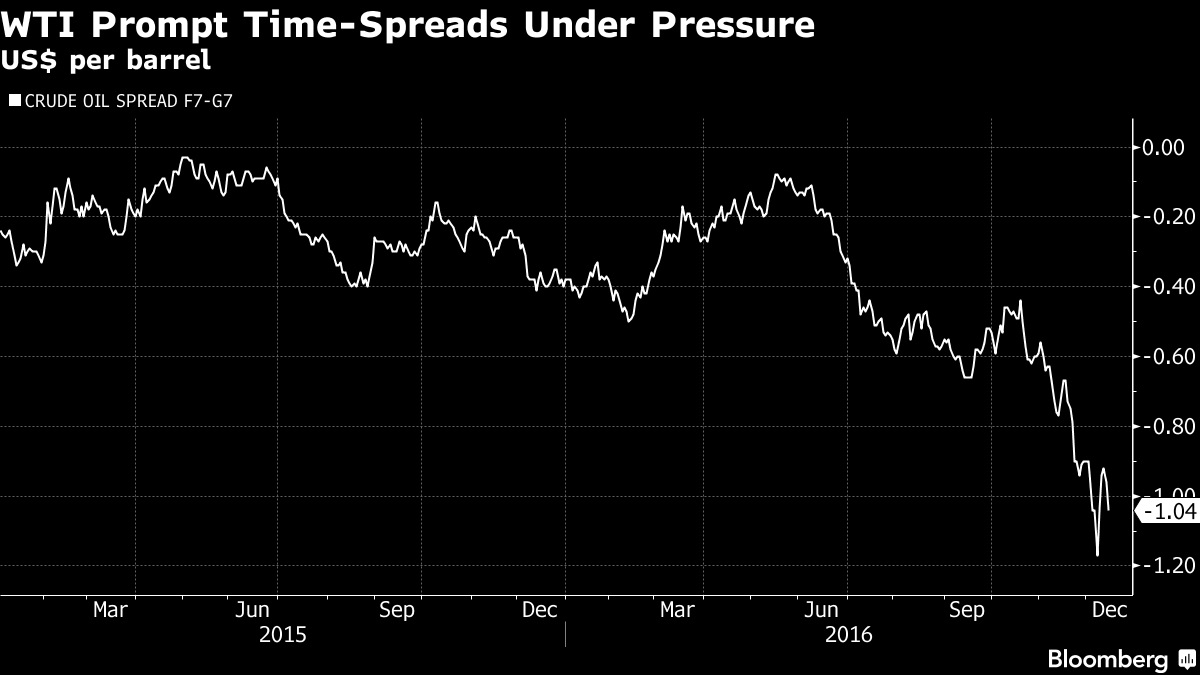
The glut is also pushing the market deeper into contango, where prompt supply is cheaper than future deliveries. The discount for WTI delivered in January widened Thursday to $1.09 a barrel below February at 12:25 p.m. London. In April, when stocks were at a similar level, the spread reached $1.55.

Pressure at Cushing

“We may continue to see pressure at Cushing, where stocks typically move higher seasonally into year-end and keep pressure on WTI prompt time spreads,” Morgan Stanley’s Longson said.

After the January contract expires, the growing glut may also weaken WTI during the so-called roll period, when traders can exchange physical crude for three days after the futures contract has expired. 

Last month, when the December contract expired, cash prices fell to $1.40 a barrel below futures, the widest spread since April.

“Once January expires you are going to see some desperate people,” said Bob Yawger, director of the futures division at Mizuho Securities USA Inc. in New York, in a telephone interview. “This bearish price structure isn’t going away.”


The impact of the Saudi production cuts will take time as Riyadh is reducing output from January onward, and Saudi crude takes about 45 days to arrive to the U.S. after sailing from the Middle East and around Africa.

“Week-over-week inventory builds at Cushing will be noise through year-end and offer an opportunity to exploit the short-term contango conditions,” said Chris Kettenmann, chief energy strategist at Macro Risk Advisors LLC in New York. “The clock starts Jan. 1 for OPEC/non-OPEC coordinated cuts.”

the healthiest and unhealthiest states in the country

USA Today
Hawaii is the healthiest state in the country for the fifth consecutive year, according to an annual state-by-state health ranking report.

The 2016 America's Health Rankings highlight some long-term improvements in overall health across the country and some disturbing new trends.

While smoking among U.S. adults decreased by 41% since the start of the report in 1990, and the percentage of the population that is uninsured decreased by 35% in the past five years, for the first time in the report’s history, cardiovascular deaths increased over the past year. Even more disturbing, over the past two years, the rate of premature death has also increased, according to Reed Tuckson, external clinical advisor United Health Foundation, a not-for-profit foundation, that sponsors the report.

“We are still living longer, but sicker, and getting sicker sooner,” Reed said. "People are experiencing obesity and related consequences earlier in life which is also a problem.”

The report also found that drug deaths increased 9% over the past five years. Tuckson said the report highlights that the nation is at a health crossroads, with positive health changes like a decrease in smoking and more insured people as wins, but troubling levels of obesity, diabetes, high blood pressure and sedentary behavior diminishing the positive steps.

"We have to remember that we have to put the fight for promoting health and prevent disease much higher on the agenda," Tuckson said. "If we don’t, we as a nation will see further slippage and see those fearful trends of premature death, people dying from cardiovascular disease at higher rates than years before."

According to the report, Hawaii ranked first in overall health, with a low percentage of uninsured people, low rates of obesity and a low prevalence of obesity. But it's not all beachy in paradise, according to the report, which notes Hawaii scores above the national average for excessive drinking.

Mississippi fell from 49th to 50th this year, according to the report, which uses data from the Centers for Disease Control and Prevention, American Medical Association, Census Bureau and even the FBI. It looks at a slew of measures of health, including tobacco and alcohol abuse, exercise, infectious diseases, crime rates, public health funding, access to immunizations, premature birth rates and cancer and heart disease rates.

Mississippi has a high prevalence of smoking, low birthweight and a high percentage of children living in poverty, according to the report. But while Mississippi has the most room for improvement, the state does have a low prevalence of excessive drinking and drug-related deaths.

Clean-living generation of children snub cigarettes and alcohol


Restrictions on smoking have become tighter, with sales from vending machines banned and displays of cigarettes banished from shopsH. Armstrong Roberts/Getty Images


Children are drinking and smoking less than ever, according to an NHS survey that points to the cleanest-living generation on record.

Experimentation with alcohol among under-16s is down by two thirds since 2003 and the number of children trying cigarettes has fallen by three quarters. Public health leaders praised a crackdown on under-age sales for improving child health but warned of little progress on exercise and obesity.

About a third of children are too heavy while only one in five is as active as they should be, according to data from 14,000 adults and children, of whom 7,000 were examined by a nurse.

Trump Meets Tech Industry Leaders With Effusive Greeting


The technology industry always has its eyes on the future, but few foresaw the scene that played out on Wednesday afternoon in Trump Tower.

One by one, the leaders of the world’s most elite and successful technology companies trooped up to the 25th floor to meet President-elect Donald J. Trump, who had criticized them and who they, in turn, had criticized. The executives did not acknowledge or speak to the press on the way in.

First everyone went around the room and introduced themselves — Jeff Bezos, of Amazon; Elon Musk, of Tesla; Tim Cook, of Apple; Sheryl Sandberg, of Facebook; Larry Page of Alphabet, Google’s parent company; Satya Nadella, of Microsoft, and other tech leaders. Mr. Trump was seated next to Peter Thiel, the tech investor who is a member of the president-elect’s transition team. Three of Mr. Trump’s children also attended.

The president-elect greeted the executives effusively after they were seated around a long rectangular conference table.

“This is a truly amazing group of people,” Mr. Trump said. “I won’t tell you the hundreds of calls we’ve had asking to come to this meeting.” Everyone laughed.

“I’m here to help you folks do well,” Mr. Trump said, adding somewhat cryptically: “And you’re doing well right now and I’m very honored by the bounce. They’re all talking about the bounce. So right now everybody in this room has to like me — at least a little bit — but we’re going to try and have that bounce continue.”

Shortly after that, the press was ushered out of the room. It wasn’t immediately clear what unfolded after that.

The technology world had been in turmoil as the meeting drew near. Some argued the chief executives should boycott the event to show their disdain for Mr. Trump’s values. Others maintained they should go and forthrightly make their values clear. And still others thought they should attend and make their accommodations with the new reality.
“There is a wide spectrum of feeling in the Valley,” said Aaron Levie, chief executive of the cloud storage company Box.

Complicating the debate was the fact that the most fervently anti-Trump elements in Silicon Valley seem to be the start-ups and venture capitalists, few of which were invited to the meeting.

In the days and hours before the meeting, various factions made their positions clear. A group of engineers and other tech workers issued a statement asserting they would refuse to participate in the creation of databases that could be used by the government to target people based on their race, religion or national origin.

The proclamation immediately drew more than 500 signatories, including employees at Google, Apple and Microsoft. During the campaign, Mr. Trump did not rule out the idea of a database of Muslims.

Another group of entrepreneurs assembled virtually this week with the same goal of preventing any erosion of civil liberties. They also accepted “a responsibility to partner with communities where the effects of rapidly changing technologies have hurt our fellow Americans.” Among those signing were Aileen Lee, a venture capitalist; Dave McClure, of the 500 Start-Ups incubator; and Lenny Mendonca, an angel investor.

Mr. Levie, of Box, a Hillary Clinton supporter who this week joined the executive council of the bipartisan policy group TechNet, believes in engagement with the new administration. “We have to face reality that this is the next four years, and the best way to make sure our values are upheld is actually push on them,” he said.

Other tech chief executives were also taking the same route of working with the new administration. Hours before Mr. Trump’s meeting with tech leaders, the president-elect announced that Mr. Musk and Travis Kalanick, Uber’s chief executive, would be among those joining his Strategic and Policy Forum, which is already stacked with businesspeople from finance and other industries. Ginni Rometty, the chief executive of IBM, had previously joined the forum.

While few in tech publicly supported Mr. Trump, his election is prodding the industry to realize it was isolating itself. For all of tech’s success in defining the first years of the 21st century, there were too many people who felt left behind.

“There is a growing divide between those who get to participate in our growth and those stuck in legacy industries,” said Mr. Levie. “Bridging that gap will require better partnership and better collaborations.”

By Mark David Smith


Police recruiters are trying to bring in hundreds of new police officers in Dallas.

Nearly 100 officers in the Dallas Police Department have quit or retired since October, according to multiple reports, worsening the department’s deficit of personnel.

Interim Police Chief David Pughes told City Council members Monday night that the department wanted to fill the next academy class with 60 officers but has only hired 30 for the February class, the Dallas Morning News reported. The department is down to 3,252 officers and wold like to have at least 3,500.

CBS 11 reported that most of the 99 who left since Oct. 1 were some of Dallas’ most experienced officers, according to the incoming president of the Dallas Police Association.

The recruitment/departure rate problems stem from the last fiscal year, which ended in September, in which 294 officers left and 142 were hired.

The Morning News reported the department has a rising crime rate on top of troubled pension funds and low salaries compared to other cities.

A recent Star-Telegram report found that the highest pay for police officers in DFW is found in the suburbs, with Hurst having the highest starting pay at $65,744. Fort Worth’s starting pay is $52,176, and Dallas is $44,658 without a 4-year college degree, $48,258 with one.

Mark David Smith: 817-390-7808, @MarkSmith_FWST

Read more here: http://www.star-telegram.com/news/local/community/dallas/article120589238.html#storylink=cpy

Bill Gates says Trump has the opportunity to be like JFK


President-elect Donald Trump has an opportunity to establish "American leadership through innovation," Bill Gates told CNBC on Tuesday.

"A lot of his message has been about ... where he sees things not as good as he'd like," the billionaire Microsoft co-founder said on "Squawk Box."

"But in the same way President Kennedy talked about the space mission and got the country behind that," Gates continued, "I think whether it's education or stopping epidemics ... [or] in this energy space, there can be a very upbeat message that [Trump's] administration [is] going to organize things, get rid of regulatory barriers, and have American leadership through innovation."

Gates said he recently spoke on the phone with Trump, and discussed the power of innovation. "Of course, my whole career has been along those lines. And he was interested in listening to that. And I'm sure there will be further conversation."

Gates said it was the first time he had spoken with Trump, though he said they have mutual friends.