"We take the stars from heaven, the red from
our mother country, separating it by white stripes, thus showing that
we have separated from her, and the white stripes shall go down to
posterity, representing our liberty."
– George Washington,
acceptance of American Flag, June 14, 1777; "Celebrating America’s
Freedoms: The United States Flag," U.S. Department of Veterans Affairs:1
Muhammad Ali, the silver-tongued boxer and civil rights champion who
famously proclaimed himself "The Greatest" and then spent a lifetime
living up to the billing, is dead. Ali died Friday at a Phoenix-area hospital,
where he had spent the past few days being treated for respiratory
complications, a family spokesman confirmed to NBC News. He was 74. "After a 32-year battle with Parkinson's
disease, Muhammad Ali has passed away at the age of 74. The three-time
World Heavyweight Champion boxer died this evening," Bob Gunnell, a
family spokesman, told NBC News. Ali had suffered for three decades from
Parkinson's Disease, a progressive neurological condition that slowly
robbed him of both his legendary verbal grace and his physical
dexterity. A funeral service is planned in his hometown of Louisville,
Kentucky. Even as his health declined, Ali did not shy
from politics or controversy, releasing a statement in December
criticizing Republican presidential candidate Donald Trump's proposal to
ban Muslims from entering the United States. "We as Muslims have to
stand up to those who use Islam to advance their own personal agenda,"
he said. The remark bookended the life of a man who burst
into the national consciousness in the early 1960s, when as a young
heavyweight champion he converted to Islam and refused to serve in the
Vietnam War, and became an emblem of strength, eloquence, conscience and
courage. Ali was an anti-establishment showman who transcended borders
and barriers, race and religion. His fights against other men became
spectacles, but he embodied much greater battles. Born Cassius Clay on Jan. 17, 1942 in
Louisville, Kentucky, to middle-class parents, Ali started boxing when
he was 12, winning Golden Gloves titles before heading to the 1960
Olympics in Rome, where he won a gold medal as a light heavyweight. He turned professional shortly afterward,
supported at first by Louisville business owners who guaranteed him an
unprecedented 50-50 split in earnings. His knack for talking up his own
talents — often in verse — earned him the dismissive nickname "the
Louisville Lip," but he backed up his talk with action, relocating to
Miami to train with the legendary trainer Angelo Dundee and build a case
for getting a shot at the heavyweight title.
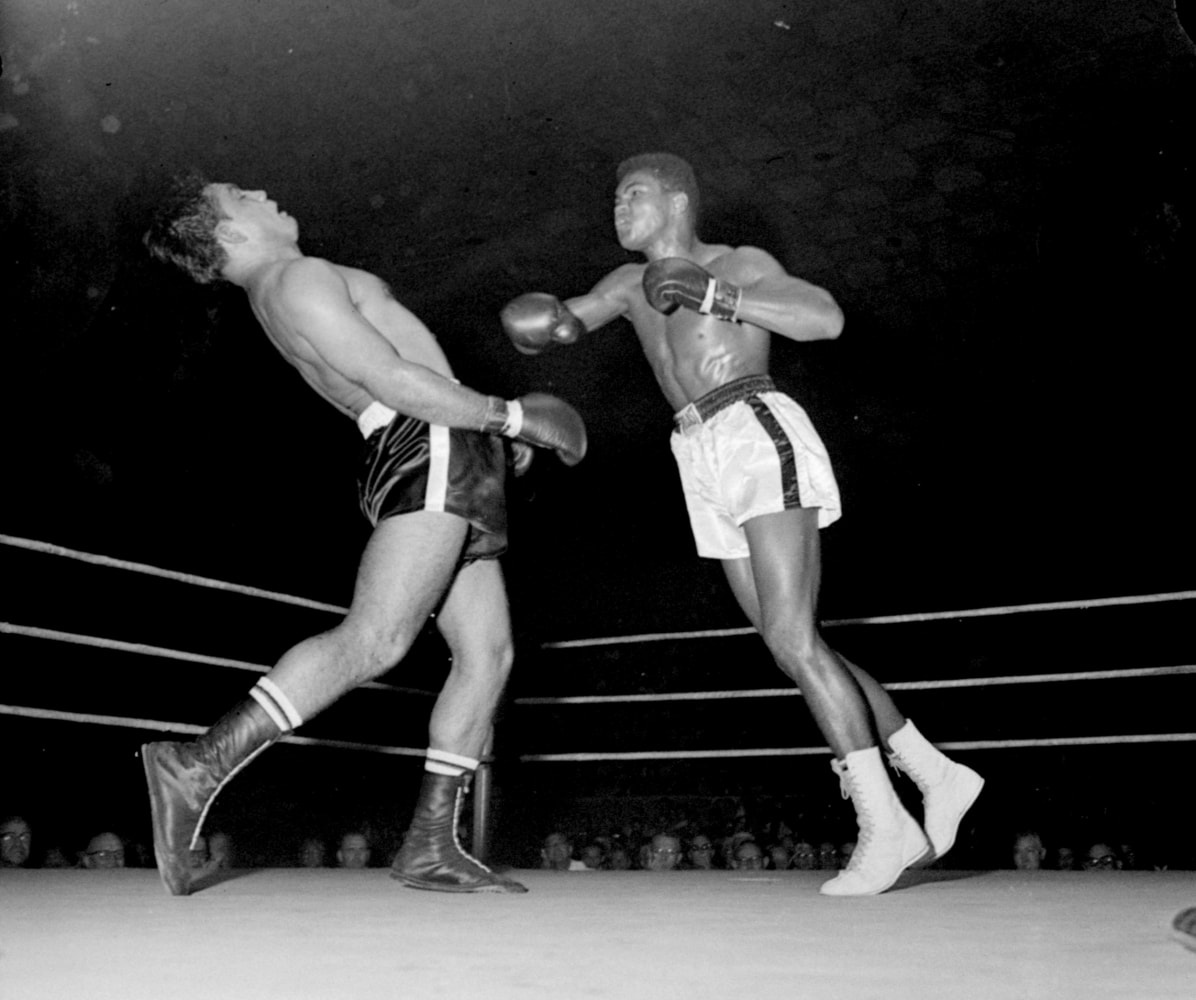
Muhammad
Ali, right, attacks Alex Mitoff in the sixth round in which Ali
clobbered the Argentinean to the canvas, on Oct. 7, 1961 in Louisville,
Ky. H.B. Littell / AP, file
As his profile rose, Ali acted out against
American racism. After he was refused services at a soda fountain
counter, he said, he threw his Olympic gold medal into a river. Recoiling from the sport's tightly knit
community of agents and promoters, Ali found guidance instead from the
Nation of Islam, an American Muslim sect that advocated racial
separation and rejected the pacifism of most civil rights activism.
Inspired by Malcolm X, one of the group's leaders, he converted in 1963.
But he kept his new faith a secret until the crown was safely in hand.
That came the following year, when heavyweight champion Sonny Liston
agreed to fight Ali. The challenger geared up for the bout with a litany
of insults and rhymes, including the line, "float like a butterfly,
sting like a bee." He beat the fearsome Liston in a sixth-round
technical knockout before a stunned Miami Beach crowd. In the ring, Ali
proclaimed, "I am the greatest! I am the greatest! I'm the king of the
world."
A Controversial Champion The new champion soon renounced Cassius Clay as
his "slave name" and said he would be known from then on as Muhammad Ali
— bestowed by Nation of Islam founder Elijah Muhammad. He was 22 years
old. The move split sports fans and the broader
American public: an American sports champion rejecting his birth name
and adopting one that sounded subversive. Ali successfully defended his title six times, including a rematch
with Liston. Then, in 1967, at the height of the Vietnam War, Ali was
drafted to serve in the U.S. Army. He'd said previously that the war did not
comport with his faith, and that he had "no quarrel" with America's
enemy, the Vietcong. He refused to serve. "My conscience won't let me go shoot my brother,
or some darker people, some poor, hungry people in the mud, for big
powerful America, and shoot them for what?" Ali said in an interview.
"They never called me nigger. They never lynched me. They didn't put no
dogs on me." His stand culminated with an April appearance at
an Army recruiting station, where he refused to step forward when his
name was called. The reaction was swift and harsh. He was stripped of
his boxing title, convicted of draft evasion and sentenced to five years
in prison. Released on appeal but unable to fight or leave
the country, Ali turned to the lecture circuit, speaking on college
campuses, where he engaged in heated debates, pointing out the hypocrisy
of denying rights to blacks even as they were ordered to fight the
country's battles abroad. "My enemy is the white people, not Vietcongs or
Chinese or Japanese," Ali told one white student who challenged his
draft avoidance. "You my opposer when I want freedom. You my opposer
when I want justice. You my opposer when I want equality. You won't even
stand up for me in America for my religious beliefs and you want me to
go somewhere and fight but you won't even stand up for me here at home."
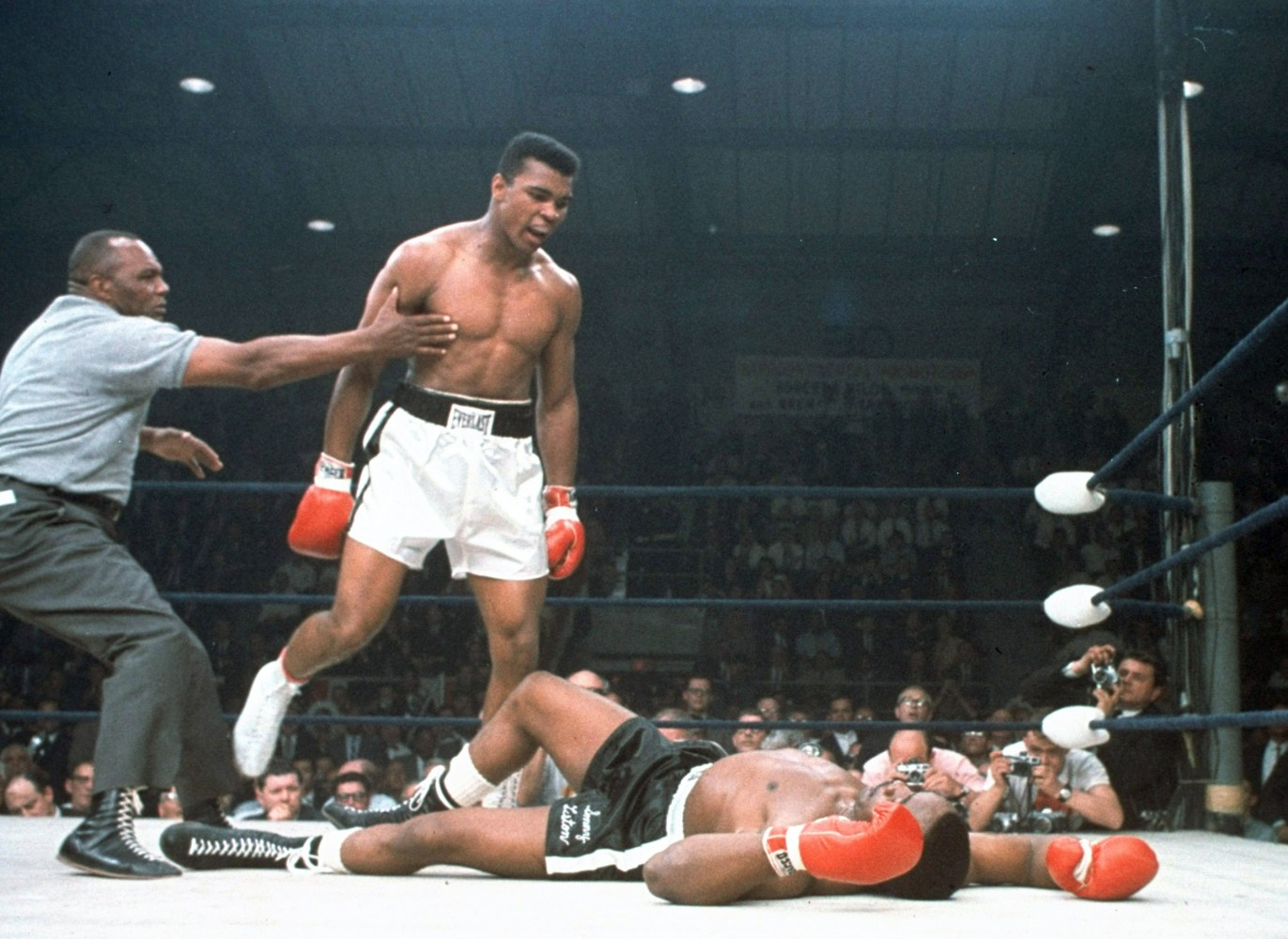
Muhammad
Ali is held back by referee Joe Walcott, left, after Ali knocked out
challenger Sonny Liston in the first round of their title fight in
Lewiston, Maine on May 25, 1965. AP, file
Ali's fiery commentary was praised by antiwar
activists and black nationalists and vilified by conservatives,
including many other athletes and sportswriters. His appeal took four years to reach the U.S.
Supreme Court, which in June 1971 reversed the conviction in a unanimous
decision that found the Department of Justice had improperly told the
draft board that Ali's stance wasn't motivated by religious belief. Return to the Ring Toward the end of his legal saga, Georgia agreed
to issue Ali a boxing license, which allowed him to fight Jerry Quarry,
whom he beat. Six months later, at a sold-out Madison Square Garden, he
lost to Joe Frazier in a 15-round duel touted as "the fight of the
century." It was Ali's first defeat as a pro. That fight began one of boxing's and sport's
greatest rivalries. Ali and Frazier fought again in 1974, after Frazier
had lost his crown. This time, Ali won in a unanimous decision, making
him the lead challenger for the heavyweight title. He took it from George Foreman later that year
in a fight in Zaire dubbed "The Rumble in the Jungle," a spectacularly
hyped bout for which Ali moved to Africa for the summer, followed by
crowds of chanting locals wherever he went. A three-day music festival
featuring James Brown and B.B. King preceded the fight. Finally, Ali
delivered a historic performance in the ring, employing a new strategy
dubbed the "rope-a-dope," goading the favored Foreman into attacking
him, then leaning back into the ropes in a defensive stance and waiting
for Foreman to tire. Ali then went on the attack, knocking out Foreman
in the eighth round. The maneuver has been copied by many other
champions since. The third fight in the Ali-Frazier trilogy
followed in 1975, the "Thrilla in Manila" that is now regarded as one of
the best boxing matches of all time. Ali won in a technical knockout in
the 15th round. Ali successfully defended his title until 1978,
when he was beaten by a young Leon Spinks, and then quickly took it
back. He retired in 1979, when he was 37, but, seeking to replenish his
dwindling personal fortune, returned in 1980 for a title match against
Larry Holmes, which he lost. Ali lost again, to Trevor Berbick, the
following year. Finally, Ali retired for good.
Muhammad
Ali, right, takes a punch from Trevor Berbick, of Canada, during the
first round of their 10-round bout in Nassau, Bahamas, in this Dec. 11,
1981 file photo. AP, file
'He's Human, Like Us'The following year, Ali was diagnosed with Parkinson's Disease."I'm in no pain," he told The New York Times. "A
slight slurring of my speech, a little tremor. Nothing critical. If I
was in perfect health — if I had won my last two fights — if I had no
problem, people would be afraid of me. Now they feel sorry for me. They
thought I was Superman. Now they can go, 'He's human, like us. He has
problems.' '' Even as his health gradually declined, Ali — who
switched to more mainstream branches of Islam — threw himself into
humanitarian causes, traveling to Lebanon in 1985 and Iraq in 1990 to
seek the release of American hostages. In 1996, he lit the Olympic flame
in Atlanta, lifting the torch with shaking arms. With each public
appearance he seemed more feeble, a stark contrast to his outsized aura.
He continued to be one of the most recognizable people in the world.
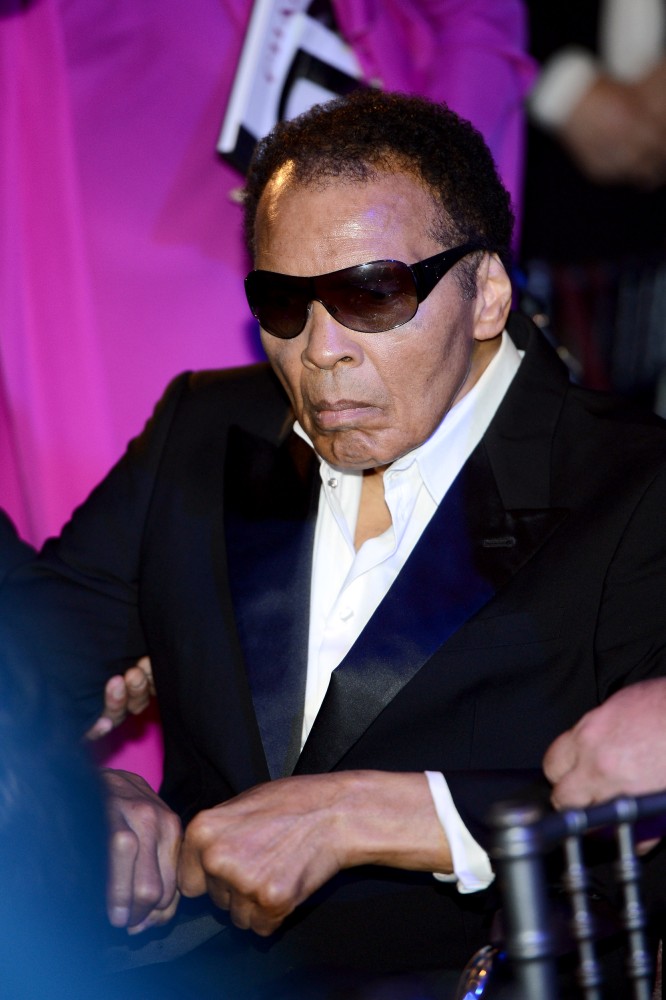
Muhammad Ali attends the Sports For Peace Fundraising Ball at The V&A on July 25, 2012 in London. Ian Gavan / Getty Images, file
He traveled incessantly for many years,
crisscrossing the globe in appearances in which he made money but also
pushed philanthropic causes. He met with presidents, royalty, heads of
state, the Pope. He told "People" magazine that his largest regret was
not playing a more intimate role in the raising of his children. But he
said he did not regret boxing. "If I wasn't a boxer, I wouldn't be
famous," he said. "If I wasn't famous, I wouldn't be able to do what I'm
doing now."
In 2005, President George W. Bush honored Ali
with the Presidential Medal of Freedom, and his hometown of Louisville
opened the Muhammad Ali Center, chronicling his life but also as a forum
for promoting tolerance and respect. Divorced three times and the father of nine
children — one of whom, Laila, become a boxer — Ali married his last
wife, Yolanda "Lonnie" Williams, in 1986; they lived for a long time in
Berrien Springs, Michigan, then moved to Arizona. In recent years, Ali's health began to suffer
dramatically. There was a death scare in 2013, and last year he was
rushed to the hospital after being found unresponsive. He recovered and
returned to his new home in Arizona. In his final years, Ali was barely able to
speak. Asked to share his personal philosophy with NPR in 2009, Ali let
his wife read his essay:
"I never thought of the possibility of failing,
only of the fame and glory I was going to get when I won," Ali wrote. "I
could see it. I could almost feel it. When I proclaimed that I was the
greatest of all time, I believed in myself, and I still do."
"I am absolutely delighted that the United States has taken up that
challenge and will host the next Invictus Games in 2016. I have no doubt
that the USA will set the bar even higher than London did and put on a
great show." Prince Harry. The Invictus Story
Most of
us will never know the full horrors of combat. Many Servicemen and women
suffer life-changing injuries, visible or otherwise, whilst serving
their country. How do these men and women find the motivation to move on
and not be defined by their injuries?
How can they be
recognized for their achievements and not given sympathy? Prince Harry
asked these questions. On a trip to the Warrior Games in the USA in 2013
he saw how the power of sport could help physically, psychologically
and socially. His mind was made up. London would host the inaugural
Invictus Games, an international sporting event for wounded, injured and
sick Service personnel.
The word ‘Invictus’ means
‘unconquered’. It embodies the fighting spirit of the wounded, injured
and sick service personnel and what these tenacious men and women can
achieve, post injury. The Games harness the power of sport to inspire
recovery, support rehabilitation, and generate a wider understanding and
respect for those who serve their country.
These Games have
shone a spotlight on the ‘unconquerable’ character of service men and
women and their families and their ‘Invictus’ spirit. These Games have
been about seeing guys sprinting for the finish line and then turning
round to clap the last man in. They have been about teammates choosing
to cross the line together, not wanting to come second, but not wanting
the other guys to either. These Games have shown the very best of the
human spirit. Prince Harry.
In the words of Prince Harry of England, “Invictus means unconquered, a
word which perfectly embodies the fighting spirit of the wounded,
injured and sick service personnel and veterans.”
Prince Harry
has been the inspiration and creator of the Invictus Games and did so
after a visit he made to the United States in 2013 to attend the
“Warrior Games”. It was at that point in time that he realized and
“fully appreciated” that sport played a vital role in helping with the
recovery process.
Prince Harry's description of the meaning of
the Invictus Games sums it up most eloquently: “I believe there is more
support we can and should give to these incredible men and women.
Reassuring them that their service will not be forgotten and that they
have every opportunity to make a full and meaningful contribution to the
communities in which they live.”
Every competitor overcame
triumphant battles at some level, just to be afforded the opportunity to
be at the starting line but what transpires is the most outstanding
showcase of competition, camaraderie and the very best of the human
spirit.
In the words of Ken Fisher, Chairman of the Invictus
Games 2016 along with Fisher House: “These games will serve as a
powerful reminder that wounded, ill, and injured servicemen and women
and their families are not alone. They will be able to share their
experiences with each other as only they can. Treating physical and
psychological trauma is just one step on the long road to recovery,
recovery that is about rediscovering self-confidence,personal ambition,
and most importantly, family healing. THAT is the spirit of the
INVICTUS GAMES. They truly are unconquered.” (emphasis added)
Mary Louise and I recently had the pleasure and honor to attend the
Annual Invictus Games being held at ESPN Wide World of Sports at Disney
World Orlando. While we were there with the initial intent of meeting
the recipient of the Orlando Rocks Benefit for 2017; with tickets
purchased and eager to go, we came to find out that the warrior would
not be competing due to prosthetic issues. We attended just the same.
Below is the account of our day with all the warriors. Enjoy folks!
In the words of Prince Harry of England, “Invictus means unconquered, a
word which perfectly embodies the fighting spirit of the wounded,
injured and sick service personnel and veterans.”
Prince Harry
has been the inspiration and creator of the Invictus Games and did so
after a visit he made to the United States in 2013 to attend the
“Warrior Games”. It was at that point in time that he realized and
“fully appreciated” that sport played a vital role in helping with the
recovery process.
Prince Harry's description of the meaning of
the Invictus Games sums it up most eloquently: “I believe there is more
support we can and should give to these incredible men and women.
Reassuring them that their service will not be forgotten and that they
have every opportunity to make a full and meaningful contribution to the
communities in which they live.”
Every competitor overcame
triumphant battles at some level, just to be afforded the opportunity to
be at the starting line but what transpires is the most outstanding
showcase of competition, camaraderie and the very best of the human
spirit.
On behalf of Mary Louise and myself, Raymond Tharaldon, we hope you
enjoy our showcase of photos and undying devotion and we would like to
say “thank you” to ALL these American and international heroes.
The extradition of Romanian hacker “Guccifer” to the
U.S. at a critical point in the FBI’s criminal investigation of Hillary
Clinton’s email use is “not a coincidence,” according to an intelligence
source close to the case.
One of the notches on Guccifer’s cyber-crime belt was
allegedly accessing the email account of Clinton confidant Sidney
Blumenthal, one of Clinton’s most prolific advice-givers when she was
secretary of state. It was through that hack that Clinton's use of a
personal account -- clintonemail.com -- first came to light.
Former law enforcement and cyber security experts
said the hacker, whose real name is Marcel Lehel Lazar, could – now that
he’s in the U.S. – help the FBI make the case that Clinton’s email
server was compromised by a third party, one that did not have the
formal backing and resources of a foreign intelligence service such as
that of Russia, China or Iran.
“Because of the proximity to Sidney Blumenthal and
the activity involving Hillary’s emails, [the timing] seems to be
something beyond curious,” said Ron Hosko, former assistant director of
the FBI’s Criminal Investigative Division from 2012-2014.
On Tuesday, Lazar appeared in an Alexandria, Va.,
federal courtroom for his detention hearing, attended by Fox News. He
faces a nine-count federal indictment on computer hacking charges and,
according to both Romanian and U.S. officials, is expected to be in the
country for 18 months.
A spokesman for the FBI’s Washington Field Office,
which led the Guccifer investigation, had no comment on the extradition,
the timing, and any potential intersection with the Clinton email
probe.
On or about March 31, Lazar was extradited 3,700
miles to Alexandria from a prison in Arad, Romania, where he has been
serving a seven-year sentence for hacking crimes committed in his native
country. His targets in Romania were prominent government officials and
political figures whom he often taunted under the name of Micul Fum or
“Little Smoke.”
Following his 2014 conviction, Lazar was effectively
neutralized in prison and no longer a threat, which makes his transfer
to the U.S. all the more noteworthy.
The 44-year-old entered the Alexandria courtroom
wearing a green jumpsuit, with the yellow word "PRISONER" stenciled on
the back. Lazar appeared confident and relaxed during the four-minute
appearance, telling the court he did not need the translator provided
for the hearing.
According to the 15-page federal indictment, Lazar
"specialized in gaining unauthorized access to the online accounts of
high-profile individuals" including Clinton ally Blumenthal, who appears
to be identified as “Victim 5 … ajournalist and former presidential advisor who was the true owner of an AOL account with subaccounts known to the grand jury.”
The indictment went on to note that using his alias
of Guccifer on Blumenthal’s account, “Lazar attempted to conceal his
identity by accessing the account from a proxy server located in
Russia.”
In early 2013, news outlets including Russia Today
and The Smoking Gun published memos from Guccifer, with excerpts of
exchanges between Blumenthal and Hillary Clinton about Libya including
details following the 2012 Benghazi terrorist attack.
In a 2015 prison interview from Romania with reporter Matei Rosca for Pando.com, Lazar told Rosca that, "I used to read [Clinton's] memos for six or seven hours ... and then do the gardening."
From London, Rosca told Fox News he is still in touch
with Guccifer’s family, including his wife Gabriela. They “lived poor
in a dusty town outside Arad. He did not profit from hacking,” he said.
Rosca emphasized that, “Guccifer has no programming
skills and guessed passwords of prominent public figures after reading
their biographies.” These included books written by Hillary
Clinton, Colin Powell and former president George W. Bush, who were also
victimized by Guccifer’s hacking.
“[Lazar] is a simple and delusional man who has a
conspiratorial streak and perhaps wasn’t aware of the damage he was
causing. His wife and daughter are back in Romania worrying about him
and they have not received a phone call yet since he has been in the
U.S.”
Rosca said Lazar also claimed to have stashed
“unpublished hacked material in the cloud, some of it relating to the
Middle East. … He said he was expecting to collaborate with U.S.
security services when the time is right. Presumably that would be now.”
Cybersecurity and terrorism expert Morgan Wright told
Fox News, “My question is, why now – why just these cases, and why was
it so important to bring him [to the U.S.]? I go back to what’s in
common, and that’s the exposure.”
The Romanian government told Fox News that the
request to extradite Lazar came from the FBI, but when Fox News asked
when the process began, a government spokesperson said they were not
authorized to comment further.
Romanian media have reported the request came on or
about Dec. 29, 2015. That would have been shortly after the intelligence
community’s identification of emails beyond “top secret” on Clinton’s
personal server, which became public in mid-January.
Clinton’s deliberate choice to use a private,
unsecure server based in her home and a private email address for her
government business as secretary of state remains under federal
investigation by the FBI while she campaigns for president. It has been
widely reported in the last month that the FBI is setting up interviews
with Clinton and her associates, what is believed to be a final phase in
the process.
The FBI declined comment on the case, and the timing,
as did representatives from the U.S. Attorney’s office for the Eastern
District of Virginia and his court-appointed federal public defender,
Shannon Quill.
Hosko, who is not part of the current email probe,
read the Guccifer indictment and told Fox News that Guccifer’s technical
skills and intent “show the relative ease of getting very close to
someone in a high place in government. Not only Hillary Clinton, but
Colin Powell and George W. Bush. … It’s important on a couple of levels.
Here is an individual in a relatively poor Eastern European country who
was able to intrude on sensitive emails about activities in Benghazi.”
While imprisoned in Romania, Guccifer reportedly met
with the FBI, members of the Secret Service and members of Cyber Command
to discuss how he accessed and read memos marked “official use only.”
Hosko noted that commitment of resources by the FBI
to extradite Guccifer to the U.S. with the cooperation of Romania is
significant.
A review of recent federal cases by Fox News found
that Guccifer’s extradition appears to be an outlier. Hackers typically
are extradited in the event of major financial theft, such as a 2013
case where three Romanian men stole in excess of $2 million in a
cyber-fraud ring – and not in cases involving a breach of personal
privacy.
Catherine Herridge is an award-winning Chief Intelligence
correspondent for FOX News Channel (FNC) based in Washington, D.C. She
covers intelligence, the Justice Department and the Department of
Homeland Security. Herridge joined FNC in 1996 as a London-based
correspondent. Pamela K. Browne is Senior Executive Producer at the FOX News
Channel (FNC) and is Director of Long-Form Series and Specials. Her
journalism has been recognized with several awards. Browne first joined
FOX in 1997 to launch the news magazine “Fox Files” and later, “War
Stories.”
by Carlos Correa FALLBROOK, Calif. – A wounded marine who survived stepping on an
improvised explosive device while deployed in Afghanistan is getting the
chance to see his new dream home.
It was all made possible through community support and the Gary Sinise Foundation.
Sergeant Nick Kimmel is a triple amputee. He lost both legs and his
left arm four years ago and says he is not letting an almost fatal
accident slow him down.
There isn’t a thing Kimmel wouldn’t do for his fellow brothers in the military.
“We always talk about how bad the Vietnam vets got treated and every
time I see someone with a Vietnam hat, I try to thank them,” he said.
On Tuesday, despite the rainfall, several of those veterans are
working together and showing just what it means to be there for one
another.
“It’s pretty fantastic. I’m not going to lie,” said Kimmel.
In 2011, Sergeant Kimmel woke up in Walter Reed National Military
Medical Center, four days after his stepping on an improvised explosive
device that went off while he was helping build a patrol base in
Afghanistan.
“Since I woke up, I kind of looked at it as in the past, you know.
You can’t change the past. It is what it is and I say that all the
time, it is what it is. All you can do is push forward,” he said.
Kimmel went through surgeries every other day for an entire month.
Eventually, his left arm and both legs above the knee had to be
amputated.
For a while, he was in a wheelchair and it made life in his
old home quite in possible.
“My wheelchair is like 3 foot wide and I’m always banging into walls.
Right now, I have carpet so, it’s hard to push on,” said Kimmel.
Through the Gary Sinise Foundation’s rise program Sergeant Kimmel is
now able to live independently with a new custom smart home solely build
with this wounded warrior in mind.
“As citizens it is our duty to ensure that our returning defenders
are welcome back into their communities with the resources to begin a
new life,” said Judith Otter, executive director of the Gary Sinise
Foundation.
Kimmel’s new home features wide-open spaces making it easier for him
to move around. The kitchen cabinets open with several levels for
better access and the home’s blinds are controlled through a touch of an
I-pad. It’s everything Kimmel says he imagined in his dream home.
“They always talk about forever homes, and this is for sure a forever home,” he said.
By the way this is the 40th home built through the Gary Sinise Foundation.
Kimmel plans to focus on his hobby of restoring cars and making his
new place as warm and comfortable for him and his service dog, Rush.
Americans are heading South and West again in search of jobs and more
affordable housing, as the nation’s economic health continues to
improve.
Census population estimates
show that the 16 states and the District of Columbia that comprise the
South saw an increase of almost 1.4 million people between 2014 and
2015. The 13 states in the West grew by about 866,000 people.
The gains represent the largest annual growth in population of the
decade for both regions and signal that the multi-decade migration to
the Sun Belt has resumed after being interrupted by the Great Recession
of 2007-09 and the economic sluggishness and anxiety that followed.
In comparison, population growth in the Northeast and the Midwest —
including what’s known as the Snow Belt — remained sluggish, growing by
about 258,000 residents combined.
“Clearly, the Snow Belt-to-Sun Belt migration is coming back after a
huge lull in response to the recession and post-recession period,” said
demographer William Frey, of the Brookings Institution.
“Up until now,
regional migration was not picking up at the same time that other
economic indicators — jobs and housing — seemed to be on the upswing.”
The numbers indicate Americans’ growing willingness to pick up and go
after having sat still earlier in the economically tenuous decade, when
the U.S. Census Bureau reported that only one in five people who wanted to move somewhere else did so.
The new estimates, released last month, arrive midway through the
decade, halfway to the next census, in 2020, and provide some
indications of where the nation is headed from the standpoint of
governing from Washington.
If the population shift continues, Texas could gain three new seats
in the U.S. House, Florida two, and Arizona, Colorado, North Carolina
and Oregon one apiece after the next census, according to an analysis by Election Data Services, a political consulting firm based in Virginia.
Nine states — Alabama, Illinois, Michigan, Minnesota, New York, Ohio,
Pennsylvania, Rhode Island and West Virginia — could meanwhile lose a
seat apiece.
Economic Reasons Drive the Moving
The shift in population reflects the economic conditions many Americans experience or aspire to.
A search for jobs and more affordable housing were behind two-thirds
of the long-distance moves made between 2014 and 2015, according to a
separate census report. Family reasons, such as getting married or rejoining relatives, accounted for another quarter of households moving.
Texas, for example — which had the biggest population gain from 2014
to 2015, an increase of 490,000 people for a total 27,469,114 — is a
magnet for job-seekers from elsewhere. It has been at the fore in high job growth and outpaced the nation’s economic growth since the recession.
Other Sun Belt states that witnessed a growth in population — such as
Georgia and Nevada — also had some of the largest increases in job
growth or economic output, as did Colorado, Oregon and Utah.
West Virginia, meanwhile, suffered a population loss of almost 5,000.
The state, which has relied economically on a declining coal industry,
has higher unemployment and lower job growth rates than the national average — giving more people more reasons to leave.
“As long as the state economy continues to stall, population loss will likely continue as well,” said Christiadi, a demographer at West Virginia University.
Six other states also had population losses for the year:
Connecticut, Illinois, Maine, Mississippi, New Mexico and Vermont. And
like West Virginia, many are struggling to provide economic opportunity.
New Mexico, Connecticut and Maine had some of the lowest rates of job
creation in recent years.
Florida’s gain of almost 366,000 people to a population of 20,271,272
was its largest in a decade and reflects another cause behind the
renewed exodus to the Sun Belt: The nation’s swollen population of baby boomers now feels more secure economically in picking up and moving to traditional retirement oases.
“The state continues to attract retiring baby boomers because of our
climate and the relatively low costs of living,” said Richard Doty, a
demographer with the University of Florida’s Bureau of Economic and Business Research.
“You can sell a home in New York or Ohio or Michigan for substantially
more than you would spend in Florida, so it’s still relatively
attractive.”
Take, for example, Sumter County, west of Orlando, one of Florida’s
fastest-growing counties, driven in large part by retirees. It is
projected to have a median age of 78 by 2020, Doty said.
A typical Sumter County home costs about $224,000 — or about half the
price of a home in a New York City suburb, such as Long Island’s Nassau
County.
Population Shifts Inside States
The influx and exodus of people has ramifications for local housing, tax bases and governments — even within state boundaries.
In Oregon, where the economy is partly being driven by chip
manufacturing for firms like Intel, young people are moving to Portland,
said Josh Lehner, an economist at the state’s Department of Economic Analysis. That’s creating a housing shortage, as construction fails to keep up with demand.
Many of Oregon’s newcomers are from neighboring California, which had
more than 77,000 people move out. That’s more than twice the number who
left between 2013 and 2014. The state showed a net increase in
population in 2014-15 of more than 350,000 only as a result of births
and new immigrants.
Many left because of housing costs. A typical home in California costs two-thirds more than in Oregon, for example.
The cost of housing can limit the number of people willing to move
into California to take even high-paying, high-tech jobs in places like
San Francisco, said John Malson, chief of demographic research at the California Department of Finance.
“You have a very good job market here in tech, so people who are
coming here are coming for the attractive job opportunities,” Malson
said. “But it’s very expensive to live in California.”
A state’s net population growth and loss numbers can sometimes cloud
what’s going on within its boundaries, meaning that some job-rich urban
areas might be flourishing but rural areas might not be.
Take Massachusetts, for example, the fastest-growing state in the Northeast.
Susan Strate, manager of population estimates at the University of
Massachusetts Donahue Institute, said young people from other states and
well-educated foreign immigrants are boosting the Boston area’s
population by taking jobs in medicine, education and biotech.
Meanwhile, she said, “Some of the little towns are losing what few young people they have.”
Illinois, whose population dropped by 22,000 people to 12,859,995, is another state undergoing a similar trend.
Chicago is attracting more businesses and young, educated
professionals to fill those jobs, while many less-expensive rural and
suburban areas with less economic opportunity struggle, said Rob Paral, a Chicago demographic consultant.
Available jobs and a person’s ability to fill them, he said, are
intertwined with population shifts — within the state, or to the Sun
Belt.
“There are many high-skill jobs overall,” Paral said. “Jobs for
lower-skill young persons are another story, combined with high housing
costs: If you are going to make the same low wage in Illinois or in a
Southwestern state, the latter offers cheaper housing and warmer
weather.”
NEWSMAX- Dreaming of overnight riches, millions of Americans anxiously checked
their tickets for the winning combination in the multi-state Powerball
lottery after a Saturday night drawing for a record $900 million
jackpot.
It was not immediate known if any ticket holder had the magic
combination of six numbers selected in the drawing: 32, 16, 19, 57, 34
and the Powerball number was 13. The grand prize for Powerball, played in 44 states, Washington, and
two U.S. territories, has climbed steadily for weeks after repeated
drawings produced no big winners. This week, ticket purchases surged
along with the size of the pot.
The grand prize in Saturday's drawing was worth $558 million if a
winner chooses an immediate cash payout instead of annual payments over
29 years, according to lottery officials in California, one of the
participating states. The prize, which rises with every drawing that produces a winning
series of six numbers held by no ticket buyer, ranks as the largest
jackpot for any lottery in North American history. With almost
unimaginable riches at stake, many Americans who normally shun lotteries
joined the long lines of people buying tickets at retail stores across
the country. Dony Elias, 26, an attendant at Stardust Liquor in Los Angeles, said
300 customers picked up tickets for Powerball last night at his store.
Elias admitted to buying a ticket for himself, something he said he had
never done before.
And like many other players, he has already given some thought to what he would do with the cash. "I would take a trip to the moon," he said. California, the nation's most populous state, normally sees Powerball
sales of $1 million a day, but on Saturday morning sales were a
head-spinning $2.8 million an hour, said California Lottery spokesman
Mike Bond. Excitement swirled among ticket buyers despite what some
statisticians call mind-boggling odds for the Powerball game - one in
292 million. Jeffrey Miecznikowski, associate professor of biostatistics at the
University at Buffalo, said in an email an American is roughly 25 times
more likely to become the next president of the United States than to
win at Powerball. Or to put it another way, the odds are equivalent to flipping a coin 28 times and getting heads every time, he said. "It doesn't sound so bad ... but you would be at it for an eternity," Miecznikowski said. November was the last time a jackpot winner emerged from Powerball, which is run by the Multi-State Lottery Association.
In the previous drawing on Wednesday night, the jackpot stood at $500
million and nobody won, setting the stage for the latest drawing just
before 11 p.m. Eastern time on Saturday. If no one has the winning numbers again, the jackpot will likely rise
to an estimated $1.3 billion by Wednesday, the next scheduled drawing,
Bond said. It may cross the $1 billion threshold on Saturday, he said. The previous record North American jackpot payout for any lottery
game was in March 2012, when $656 million was won in the multi-state
Mega Millions draw.